
Blog · · updated 23 November 2026
Cycling cadence: what is ideal and how to train it
Cycling cadence: what it is, what studies show about 60, 80, 90 and 120 rpm and how to train without punishing the knee. Guide for amateurs, Lisbon.
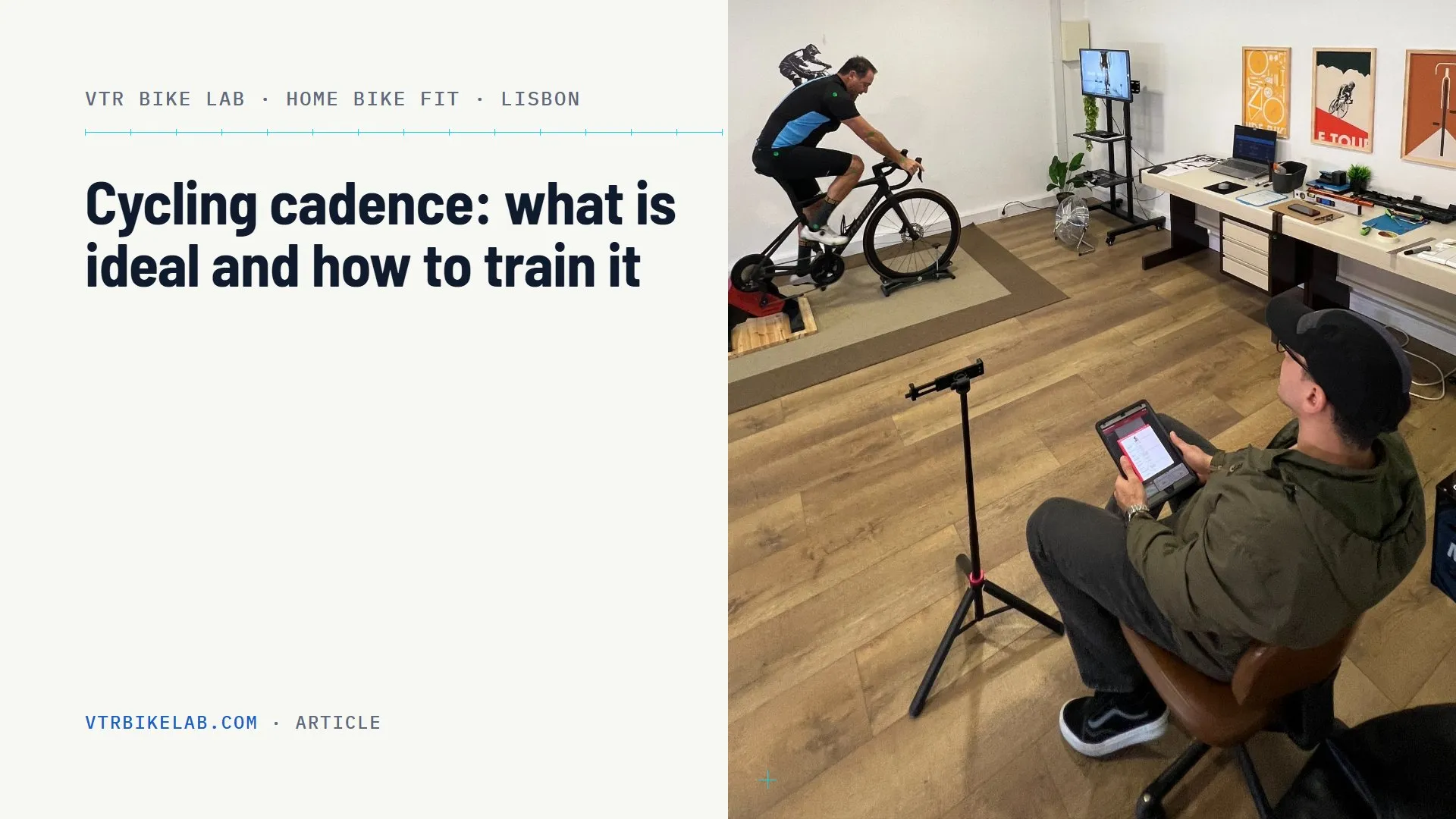
Short answer: Cadence is the number of turns the pedals make per minute (rpm). There is no one right number for everyone. In 14 elite cyclists, in a time trial of about 30 minutes, 80 rpm was the most efficient cadence, and the freely chosen cadence, 90 rpm on average, gave the same time as 80 and 100 (Foss & Hallén, 2005).
Cycling cadence: what does it mean?
It is the speed at which your legs turn. It is measured with a sensor on the crank or on the pedal, connected to the bike computer. Without a sensor, count the turns of one leg in 15 seconds and multiply by four.
| Term | What it means |
|---|---|
| rpm | full turns of the pedal in one minute |
| High cadence | fast legs, easier gear |
| Low cadence | slow legs, harder gear |
| Freely chosen cadence | the one you choose without thinking about it |
At the same speed, gear and cadence go together: an easier gear gives more rpm; a harder gear gives fewer.
What is the ideal cadence in cycling?
The one that lets you sustain the effort without forcing it. The most cited study imposed different cadences in the same time trial and compared the times with those at 80 rpm:
| Cadence | Result compared with 80 rpm | Source |
|---|---|---|
| 60 rpm | 3.5% slower | Foss & Hallén, 2005 |
| 80 rpm | the most efficient | Foss & Hallén, 2005 |
| Freely chosen (average of 90 rpm) | the same as 80 and 100 rpm | Foss & Hallén, 2005 |
| 100 rpm | 1.7% slower | Foss & Hallén, 2005 |
| 120 rpm | 10.2% slower | Foss & Hallén, 2005 |
Mind the limitation: these were 14 elite men, in a laboratory, for half an hour. It is not you on a two-hour ride. So “90 rpm” is not a rule, it is the average of what they chose.
High or low cadence: which is better for the knee?
For the knee, what counted in the studies was the load and the saddle height, not the cadence. In the laboratory, in 6 men, the force on the kneecap joint rose with more load and with a lower saddle; changing the cadence did not alter it significantly (Ericson & Nisell, 1987).
- More load, such as climbing faster or with more power: more force on the kneecap.
- Low saddle: more force on the kneecap, whatever the cadence.
- Cadence, in itself: no significant difference in the force.
If the front of your knee complains on the climbs, look first at the saddle height, that is, at your position. Then, also, at the load: climbing more slowly is less load, and it was the load that increased the force on the kneecap.
Should I pedal “in circles”?
There is no need. In eight cyclists at 90 rpm, pedalling “in circles” gave the same efficiency as the natural pedal stroke; pulling the pedal up lowered gross efficiency from 20.2% to 19.0% (Korff, 2007).
- Natural pedal stroke: your reference.
- “In circles”: the same as the natural one.
- Pulling on the pedal upstroke: it looks better on the graph, it costs the body more.
How do you train cadence?
Little by little and with your gears, not with willpower:
- Measure your freely chosen cadence on the flat, on a relaxed ride.
- On the flat, do short blocks in an easier gear with loose legs; then go back to your own rhythm.
- On the climbs, shift to the easier gear before the cadence drops a lot.
- Repeat for weeks and measure your freely chosen cadence again.
A concrete example
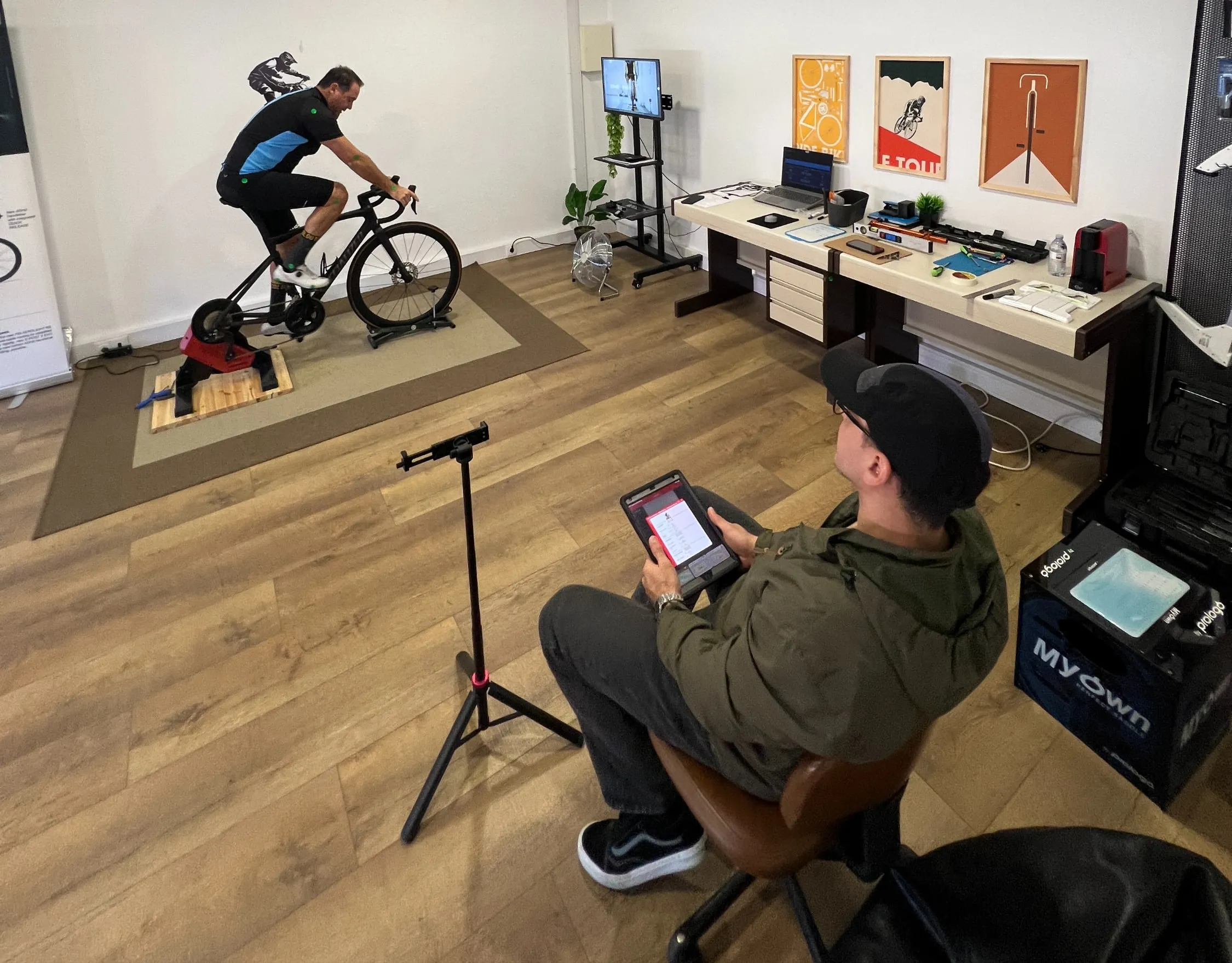
A road cyclist with a complaint at the front of the knee only on the climbs. On the flat he pedalled freely; climbing, he used the hardest gear he could manage, with slow pedal strokes. On the turbo trainer, I filmed him under load and measured the knee flexion at the lowest point of the pedal stroke.
The saddle was low for what the video showed: I raised it in small steps, filming between each step. In addition, we agreed that he would shift to an easier gear before each climb. He was to tell me, after two weeks, how the knee was responding on the same climbs.
What to do today
- Connect a cadence sensor or count the turns of one leg in 15 seconds.
- Choose the gear for your next climb before the road tilts up.
- Note the cadence at which you feel good on the flat, without copying anyone else’s.
When to ask for help
- Coach: if you want to work on cadence within a plan.
- Doctor: pain that does not go away with rest, swelling, loss of strength or locking of the knee.
- Position measurement: if your knee complains when you pedal, especially under load. Poorly dosed training on top of a poorly adjusted position is the perfect pairing for pain and injuries. In a bike fit I film you pedalling and measure the knee under effort.
Frequently asked questions
What is the average cadence in cycling? There is no average that works as a target. In one study, elite cyclists freely chose 90 rpm on average in an effort of about 30 minutes (Foss & Hallén, 2005). Amateurs on long rides were not studied in that work.
Is a high cadence in cycling less tiring? It depends. In the 6 men studied, the force on the kneecap rose with the load and with a low saddle; changing the cadence, in itself, did not alter it significantly (Ericson & Nisell, 1987). And in the elite cyclists, 120 rpm was 10.2% slower than 80 rpm (Foss & Hallén, 2005). Legs that are too fast have a cost too.
Do I need a cadence sensor? It is not essential. It helps you get to know your pattern and choose gears in time. Without a sensor, count the turns of one leg in 15 seconds and multiply by four.
Sources
- Foss Ø, Hallén J. Cadence and performance in elite cyclists. Eur J Appl Physiol. 2005;93(4):453-62. DOI 10.1007/s00421-004-1226-y · PMID 15503124 — https://pubmed.ncbi.nlm.nih.gov/15503124/
- Ericson MO, Nisell R. Patellofemoral joint forces during ergometric cycling. Phys Ther. 1987;67(9):1365-9. DOI 10.1093/ptj/67.9.1365 · PMID 3628491 — https://pubmed.ncbi.nlm.nih.gov/3628491/
- Korff T, Romer LM, Mayhew I, Martin JC. Effect of pedaling technique on mechanical effectiveness and efficiency in cyclists. Med Sci Sports Exerc. 2007;39(6):991-5. DOI 10.1249/mss.0b013e318043a235 · PMID 17545890 — https://pubmed.ncbi.nlm.nih.gov/17545890/