
Blog · · updated 24 November 2026
Is a bike fit worth it? Who it's for, when, what to expect
A bike fit is worth it when pain comes back, with a new bike or new equipment. Who it's for, when to have one and what the evidence says. Lisbon, Portugal.
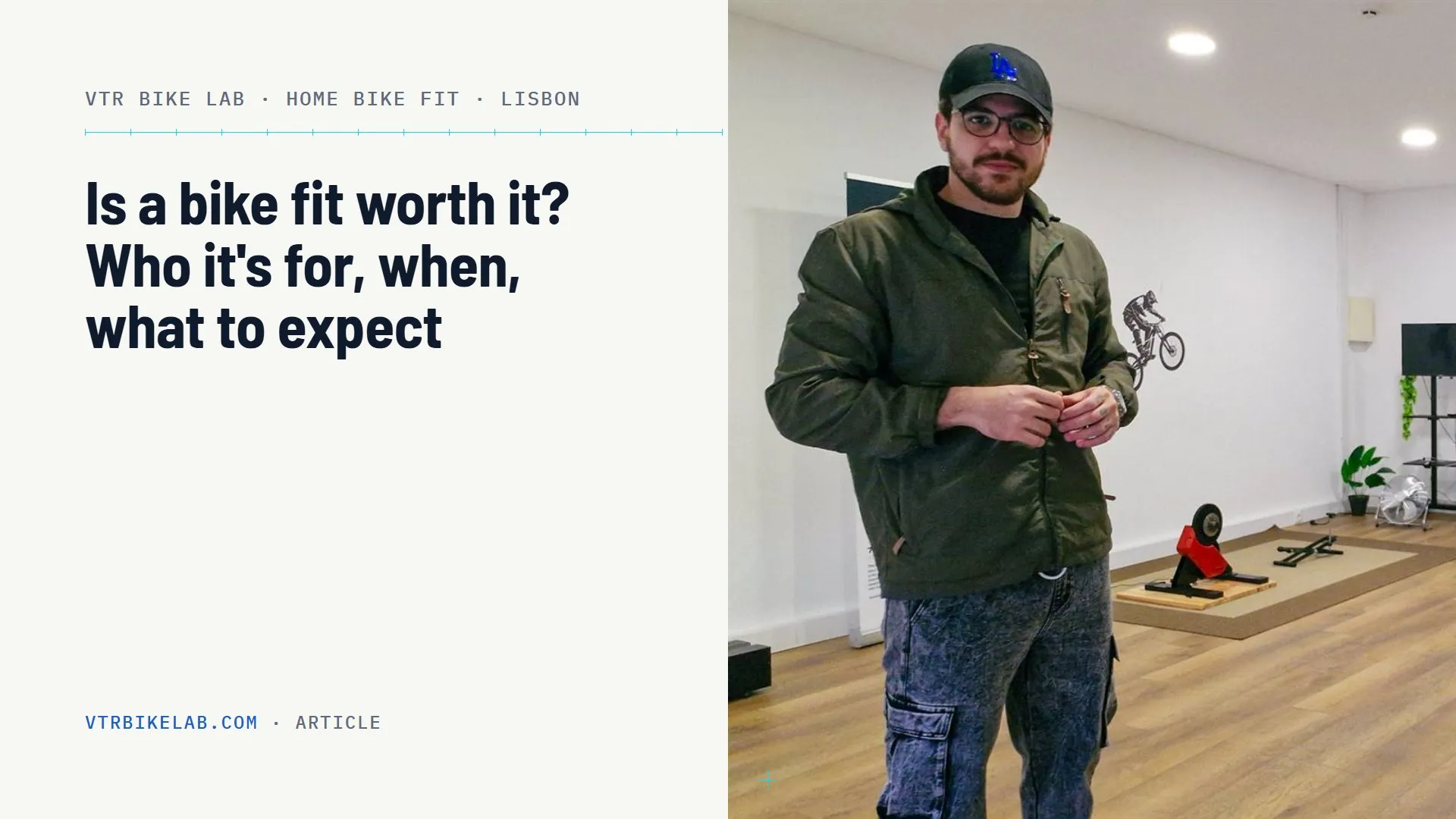
Short answer: It is worth it when a pain comes back to the same place, when you changed bike, shoes or saddle, or when nobody has ever watched you pedal. In a trial with 162 amateurs, the bike fit reduced pain and fatigue and increased comfort compared with written recommendations, with a short follow-up (Dias Scoz, 2025). With a new bike and no complaints, it lets you start with your position already measured, instead of trial and error.
Who is a bike fit worth it for?
For anyone with a concrete reason. The table sums up how I think:
| Your situation | Is it worth it now? |
|---|---|
| Pain that always comes back to the same place | Yes, before swapping parts |
| New or used bike, with nobody adjusting it with you | Yes |
| You changed shoes, cleats or saddle | Yes, the position changed |
| You are going to do longer rides or an event | It makes sense |
| You started a few weeks ago and nothing hurts | Yes, so you start from a measured position instead of trial and error |
| Pain that radiates, tingling that doesn’t go away, loss of strength | No: doctor first |
Saddle height counts: in most of the studies reviewed by Bini (2011), changing saddle height by 5% altered knee kinematics by 35%.
Bike fit for beginners: when to have one?
With the first complaint that repeats itself, or right at the start, so you begin from a measured position while your pedal stroke is still forming.
At home, the basics you can do right now:
- Saddle height by one method only, with the measurement noted down.
- Saddle level.
- Cleats properly tightened and aligned the same way on both shoes.
A formula on its own is not enough. Among well-trained cyclists, 56.5% had the saddle outside the range of 106–109% of inseam, and that range did not guarantee 30–40° of knee flexion while pedalling (Ferrer-Roca, 2012).
Bike fit for mountain bike (MTB) and road: is it the same thing?
The method is the same: saddle, handlebar and pedals, measured while pedalling. The priorities change.
| Road | MTB | |
|---|---|---|
| Position | a long time in the same one | changes with the terrain |
| Handlebar | drop bar, several hand positions | flat bar, one hand position |
| Saddle | height and setback | height measured with the post fully up, if it is a dropper post |
What to expect from a bike fit?
In a trial with 162 amateur cyclists, those who had a bike fit with motion analysis reported less pain, less fatigue and more comfort than those who received only written recommendations. The follow-up was 15 days (Dias Scoz, 2025): a good sign, but short.
Complaints are common: in a survey of 518 recreational cyclists, 85% reported at least one overuse complaint, mainly in the neck and the knee (Wilber, 1995).
- Expect: position measured, adjustments in the session, measurements in writing.
- Do not expect: a diagnosis, treatment, “it will never hurt again”.
When something hurts, position is the first thing to measure; besides position, training load counts too. Poorly dosed training on top of a badly adjusted position is the perfect pair for pain and injuries.
A concrete example
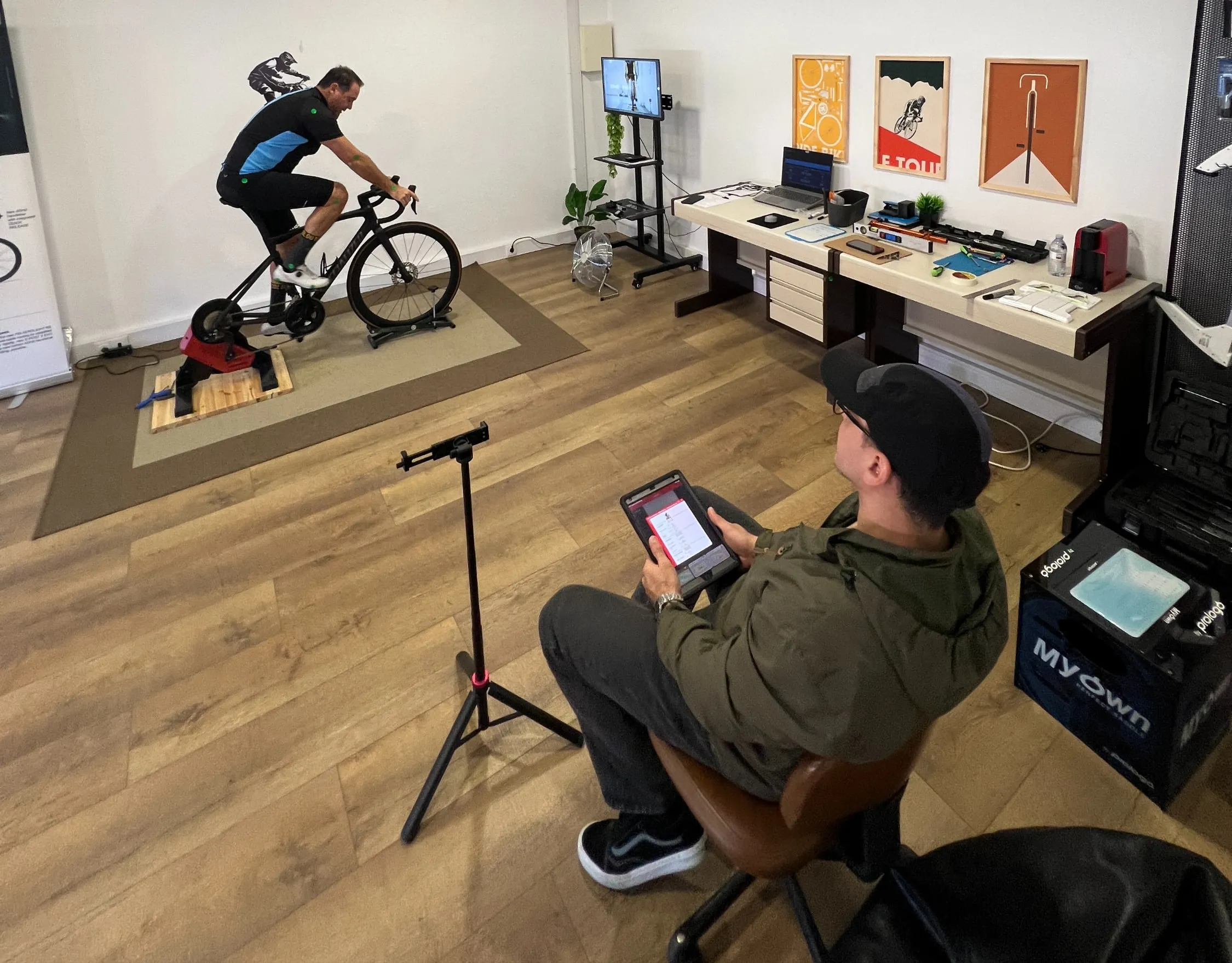
Think of a road cyclist who switched to shoes with cleats and started to feel the front of his knee on climbs. Before he buys another saddle or other shoes, I film him pedalling on the turbo trainer.
If on video the flexion at the bottom goes past 40°, above the 30–40° window (Ferrer-Roca, 2012), the saddle is low, and a low saddle is associated with more force on the kneecap (Bini, 2011). I raise it a few millimetres, film again and only then look at the cleats.
What to do today
- Write down your complaints, where they appear and after how long.
- List what you changed in the last few months: bike, shoes, saddle, kilometres.
- Measure your saddle height and keep the number before changing anything.
When this gets measured
If you recognise yourself in the table, it makes sense to measure. In the bike fit, at your home, I film you pedalling on the trainer, measure the five angles and adjust the saddle, the handlebar and the cleats in the session itself.
If there is pain that radiates, loss of strength or a change in sensation, you see a doctor first.
Frequently asked questions
Is a bike fit worth it? It is when there is a concrete reason: pain that comes back, new equipment, or nobody has ever watched you pedal. In a trial with 162 amateurs it reduced pain and fatigue, with a 15-day follow-up (Dias Scoz, 2025). With no complaints and at the start, it lets you begin from a measured position straight away.
How much does a bike fit cost? VTR BIKE LAB does the bike fit at your home, in Sintra, Cascais and Lisbon: Bike Fit Urbano, €127 (normal shoes), or Bike Fit Performance, €159 (clipless shoes, with cleat adjustment). Both include the off-the-bike tests, video, adjustments, reassessment in the software and a report on video and as a PDF, with travel included.
Bike fit for beginners: does it make sense? It does: with the first complaint that repeats itself, or right at the start, so you begin from a measured position. In the meantime, set your saddle height by one method and level the saddle. While your pedal stroke changes, the position may need a new adjustment.
Sources
- Dias Scoz R et al. Randomised clinical trial with 162 amateur cyclists: bike fit session with kinematic analysis vs written recommendations; 15-day follow-up. Sports Biomech. 2025;24(3):624-637 (epub 2022). DOI 10.1080/14763141.2022.2140701 · PMID 36408812 — https://pubmed.ncbi.nlm.nih.gov/36408812/
- Ferrer-Roca V, Roig A, Galilea P, García-López J. Influence of saddle height on lower limb kinematics in well-trained cyclists: static vs. dynamic evaluation in bike fitting. J Strength Cond Res. 2012;26(11):3025-9. DOI 10.1519/JSC.0b013e318245c09d · PMID 22190163 — https://pubmed.ncbi.nlm.nih.gov/22190163/
- Bini R, Hume PA, Croft JL. Effects of bicycle saddle height on knee injury risk and cycling performance. Sports Med. 2011;41(6):463-76. DOI 10.2165/11588740-000000000-00000 · PMID 21615188 — https://pubmed.ncbi.nlm.nih.gov/21615188/
- Wilber CA et al. An epidemiological analysis of overuse injuries among recreational cyclists. Int J Sports Med. 1995;16(3):201-6. PMID 7649713 — https://pubmed.ncbi.nlm.nih.gov/7649713/