
Blog · · updated 24 November 2026
Bike fit: what it is, how it works and what gets measured
A bike fit measures your position on the bike, at rest and pedalling, with adjustments to saddle, handlebar and pedals. The session step by step, in Lisbon.
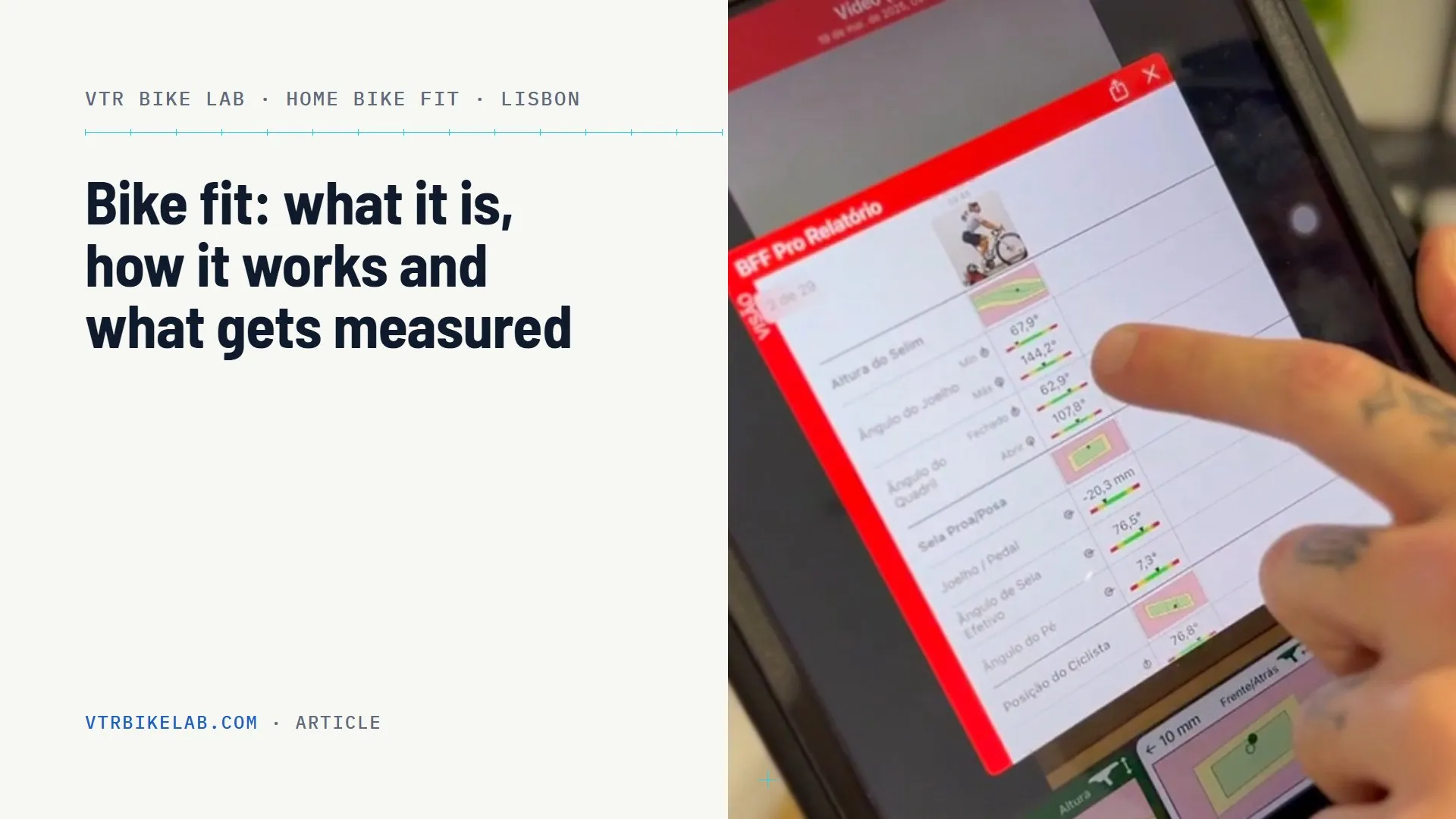
Short answer: A bike fit (or bike fitting) is the measurement of your position on the bike, at rest and pedalling, followed by adjustments to the saddle, the handlebar and the pedals. The session has seven steps: I come to your home with the measuring equipment, functional tests and biomechanical assessment off the bike, cleat adjustment, video of your pedalling on the turbo trainer, bike adjustment, reassessment of the angles in the software and a report on video and as a PDF. It does not diagnose or treat: it measures how you pedal and adjusts the bike to your body.
Bike fit: what is it, in simple words?
It is fitting the bike to the person who rides it. The bike leaves the factory the same for everyone of the same size; your body is not the same as anyone else’s.
The work is done at the three points where you touch the bike:
- Saddle: height, setback and tilt.
- Handlebar and stem (the part that holds the handlebar): height and reach.
- Pedals and cleats: where the foot rests and how much it can rotate.
Bikefit, bike fitting and biomechanical analysis are different names for the same work.
Bike fit: how does the session work, step by step?
| Step | What I do | What that tells me |
|---|---|---|
| 1. I come to your home | I bring the measuring equipment and start with a conversation: where you feel discomfort, for how long, what rides you do | where to start |
| 2. Tests off the bike | functional tests and biomechanical assessment: flexibility, asymmetries, inseam, footwear | your movement limitations |
| 3. Cleats | I adjust the cleats on your shoes (in normal shoes, this step is skipped) | where the foot rests and how much it can rotate |
| 4. Video on the trainer | I film you pedalling, at an easy pace and at a hard pace | all the angles, how you actually move |
| 5. Adjustments | saddle, stem, handlebar and pedals, according to your limitations, one change at a time | the effect of each change |
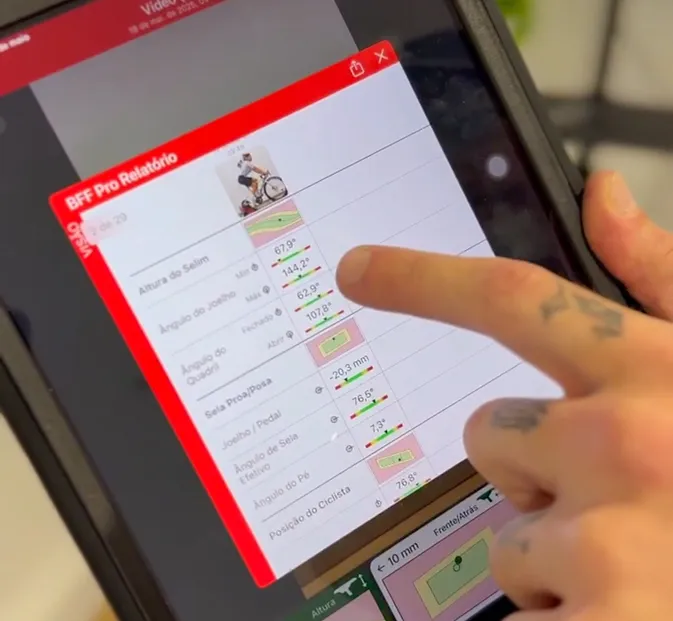
| 6. Reassessment | I measure all the angles again in the software | whether the adjustments worked |
| 7. Report | full report on video and as a PDF, with the final measurements | how to repeat the position on another bike |
One change at a time has a simple reason: if I change three things at once, I don’t know which of them made the difference.
What does each measurement say?
The most studied is knee flexion with the pedal at the bottom. The rest has little research, and you should know that.
| Measurement | How it is measured | What it tells me |
|---|---|---|
| Knee | at rest, with a goniometer: 25–35° of flexion (Holmes, 1994) | whether the saddle is high or low |
| Knee | on video, pedalling: 30–40° (Ferrer-Roca, 2012) | the same, now in motion |
| Foot | on video, at the lowest point | whether the ankle compensates for a high saddle |
| Hip and trunk | on video | how much the body closes over the legs |
| Shoulder | on video | whether the handlebar is far or near |
For the hip, the shoulder and the elbow, published reference values are lacking (Swart & Holliday, 2019). There I use the video, what you feel and the comparison before and after each adjustment.
Why measure at rest and while pedalling?
Because the number changes. From static to pedalling, the foot points further down and knee flexion increases; the variation seems greater in novice cyclists (Peveler, 2012).
- At rest: quick and repeatable, a good starting point.
- Pedalling: shows compensations, such as the ankle stretching or the hip rocking.
- At different intensities: on video, the reference goes from 33–43° at a low pace to 30–40° at a high pace (Swart & Holliday, 2019).
What to expect from a bike fit?
In a trial with 162 amateur cyclists, those who had a bike fit with motion analysis reported less pain and fatigue and more comfort than those who received only written recommendations (Dias Scoz, 2025).
The follow-up was 15 days: it is short and says nothing about months or years.
- Expect: your position measured, adjustments made in the session, the measurements in writing.
- Do not expect: a diagnosis, treatment or a guarantee that it will never hurt again.
A concrete example
Think of a mountain bike (MTB) rider who set her saddle by the heel method and feels the back of her knee on long climbs. At rest, with the goniometer, the knee looks inside the window.
On video, at a hard pace, the foot points sharply down at the bottom of the pedal stroke: it is the ankle compensating for a high saddle. I lower the saddle a few millimetres, film at the same pace and confirm in the software that the foot has stopped stretching. It all goes in the report, on video and as a PDF.
What to do today
- Measure your inseam barefoot, standing against the wall, with a book between your legs.
- Film yourself from the side on the trainer, at an easy pace and at a hard pace, and compare the foot.
- Write down where you feel discomfort and after how long it appears.
When this gets measured
If nobody has ever watched you pedal, if you changed bike or if the same pain comes back, it makes sense to measure. In the bike fit, at your home, in Sintra, Cascais and Lisbon, I do these seven steps and adjust in the session itself. The bike is set up on the trainer: yours or, if you don’t have one, mine.
If there is pain that radiates, loss of strength or numbness that doesn’t go away, the first step is the doctor.
Frequently asked questions
Bike fit: what is it? It is the measurement of your position on the bike, at rest and pedalling, with adjustments to the saddle, the handlebar and the pedals. It is not a medical examination: it measures and adjusts, it does not diagnose or treat.
How does a bike fit work? I come to your home with the measuring equipment, run functional tests and a biomechanical assessment off the bike, adjust the cleats (in Performance), film your pedalling on the trainer with the five angles (knee, hip, trunk, shoulder and foot), adjust the bike to your limitations, reassess the angles in the software and hand over the full report on video and as a PDF. VTR BIKE LAB does the session at your home, in Sintra, Cascais and Lisbon, with the bike on the trainer. Bike Fit Urbano is for normal shoes; Performance, for clipless shoes, includes cleat adjustment.
How much does a bike fit cost? VTR BIKE LAB does the bike fit at your home, in Sintra, Cascais and Lisbon: Bike Fit Urbano, €127 (normal shoes), or Bike Fit Performance, €159 (clipless shoes, with cleat adjustment). Both include the off-the-bike tests, video, adjustments, reassessment in the software and a report on video and as a PDF, with travel included.
Sources
- Holmes JC, Pruitt AL, Whalen NJ. Lower extremity overuse in bicycling. Clin Sports Med. 1994;13(1):187-205. PMID 8111852 — https://pubmed.ncbi.nlm.nih.gov/8111852/
- Ferrer-Roca V, Roig A, Galilea P, García-López J. Influence of saddle height on lower limb kinematics in well-trained cyclists: static vs. dynamic evaluation in bike fitting. J Strength Cond Res. 2012;26(11):3025-9. DOI 10.1519/JSC.0b013e318245c09d · PMID 22190163 — https://pubmed.ncbi.nlm.nih.gov/22190163/
- Peveler WW, Shew B, Johnson S, Palmer TG. A kinematic comparison of alterations to knee and ankle angles from resting measures to active pedaling during a graded exercise protocol. J Strength Cond Res. 2012;26(11):3004-9. DOI 10.1519/JSC.0b013e318243fdcb · PMID 22158094 — https://pubmed.ncbi.nlm.nih.gov/22158094/
- Swart J, Holliday W. Cycling Biomechanics Optimization—the (R)Evolution of Bicycle Fitting. Curr Sports Med Rep. 2019;18(12):490-6. DOI 10.1249/JSR.0000000000000665 · PMID 31834181 — https://pubmed.ncbi.nlm.nih.gov/31834181/
- Dias Scoz R et al. Randomised clinical trial with 162 amateur cyclists: bike fit session with kinematic analysis vs written recommendations; 15-day follow-up. Sports Biomech. 2025;24(3):624-637 (epub 2022). DOI 10.1080/14763141.2022.2140701 · PMID 36408812 — https://pubmed.ncbi.nlm.nih.gov/36408812/