
Blog · · updated 24 November 2026
Bike fit online, at home or in person: what changes
How to do a bike fit at home, what an online calculator is worth and what you only see pedalling, in person. With what the studies say. Lisbon, Portugal.
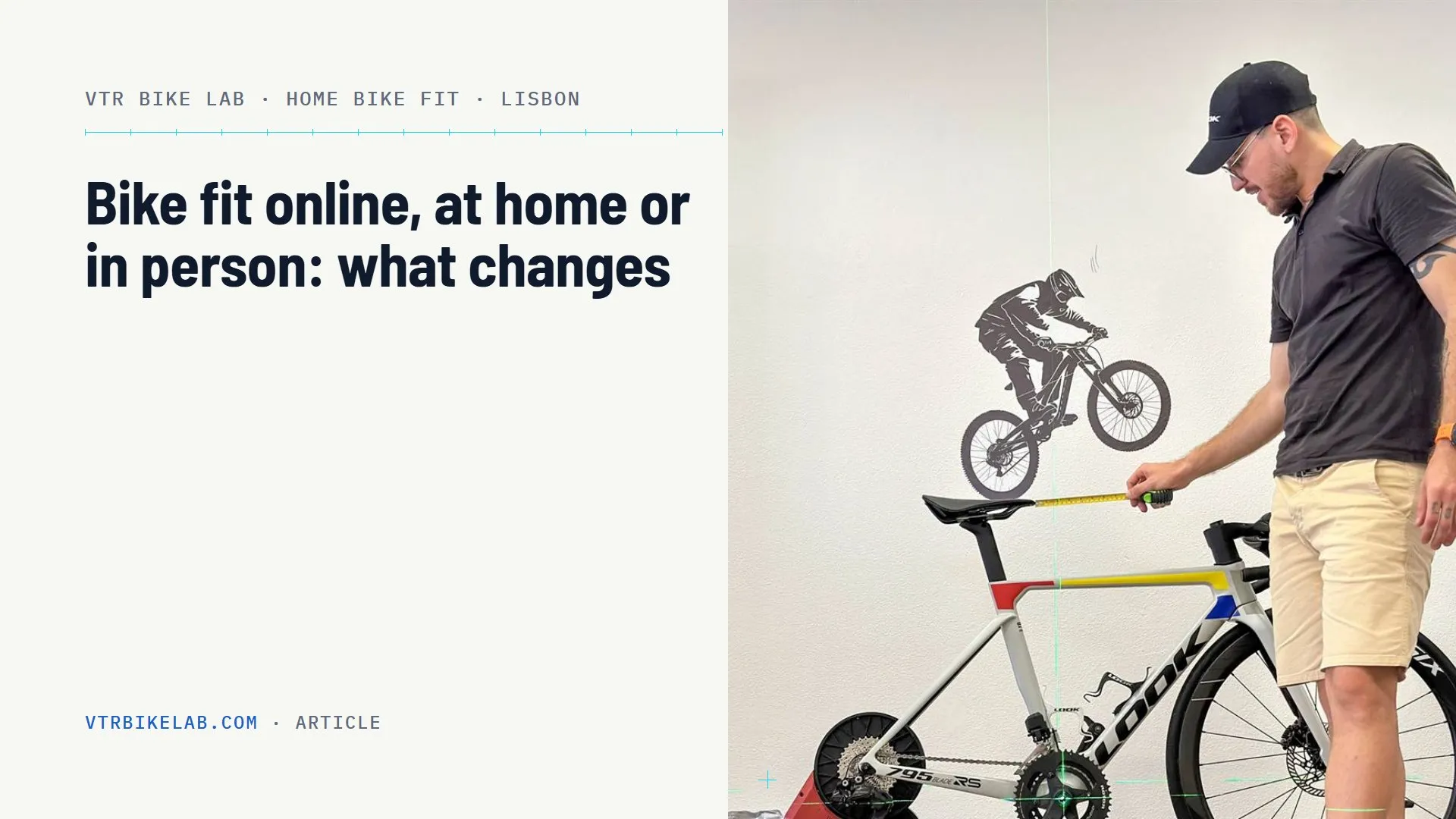
Short answer: Doing a bike fit at home is enough to get the basics right: measuring your inseam, levelling the saddle and getting close on height. An online calculator gives you a starting number, not a position: the knee angle and the inseam formula do not give the same height (Peveler, 2008). Only in person can someone see how you move while pedalling, at different paces, adjusting and filming straight afterwards.
How to do a bike fit at home?
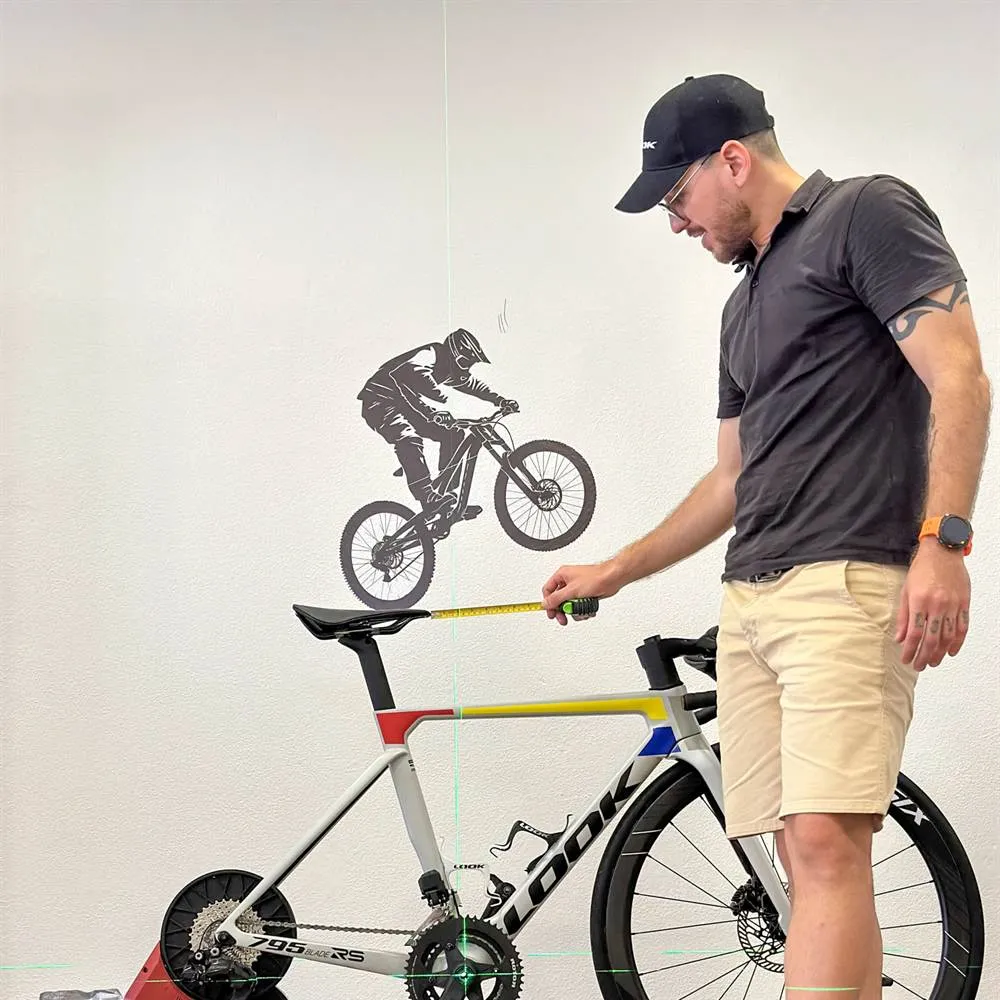
With a tape measure, a spirit level and your phone you can make a starting point. It is not a bike fit, but it is better than setting things by eye.
- Measure your inseam barefoot, back against the wall, with a book between your legs.
- Level the saddle with a spirit level or a phone app.
- Choose one method for saddle height and note the measurement.
- Film yourself from the side on the turbo trainer, with the phone at bottom bracket height.
- Change one thing at a time, a few millimetres, and ride like that before changing the next.
What falls short at home: you can’t see yourself from the outside, and choosing the method is already a technical decision, because the methods disagree.
Bike fit calculator: is the number any use?
It is useful to start with. Calculators use inseam formulas, and the formula does not give the same height as measuring the knee, at rest or pedalling.
| Study | Who | What it showed |
|---|---|---|
| Peveler, 2008 | 15 people, 10 of them non-cyclists | 25° of knee flexion gave lower oxygen consumption than 35° and than 109% of inseam |
| Ferrer-Roca, 2012 | well-trained cyclists | 56.5% had the saddle outside 106–109% of inseam, and that range did not guarantee 30–40° of flexion while pedalling |
Peveler himself (2008) points out that the 25–35° knee angle and 109% of inseam do not produce similar saddle heights. A calculator number is a hypothesis, not an answer.
Free online or virtual bike fit: what do you get and what don’t you get?
| At home | Online or virtual | In person | |
|---|---|---|---|
| Who watches you pedal | nobody | a camera, if you send video | me, live |
| At what pace | whatever you manage to film | that of the video you send | easy and hard, on the trainer |
| Who works on the bike | you | you | me, in the session |
| Confirmation | by feel | a new video, if you send one | I film again straight afterwards |
I don’t know of any study that compares an online bike fit with an in-person one. So I don’t tell you that one is better in numbers; I tell you what each one is able to see.
Why does video of you pedalling change the result?
Because at rest and pedalling it is not the same body. From static to pedalling, the foot points further down and knee flexion increases; the variation seems greater in novices (Peveler, 2012).
- Intensity also changes the number: on video, 33–43° at a low pace and 30–40° at a high pace (Swart & Holliday, 2019).
- Hip, shoulder and elbow have little research and reference values are lacking (Swart & Holliday, 2019).
A concrete example
Think of someone who used an online calculator, set the saddle to the measurement given and feels the back of the knee after an hour. At home, the tape confirms the calculator’s number.
On the trainer, I film from the side, at an easy pace and at a hard pace. If knee flexion at the bottom is below 30° on video (Ferrer-Roca, 2012), the saddle is high for that body, even with the “right” number. I lower it little by little and film again.
What to do today
- Use the calculator only for the first number, and note it down.
- Film yourself from the side with the phone at bottom bracket height, at different paces.
- Change one thing at a time, a few millimetres.
When this gets measured
If what you did on your own at home is not enough, or if the same pain comes back, the in-person bike fit is also done at your home, in Sintra, Cascais and Lisbon: I film you pedalling on the trainer, measure the five angles and adjust the saddle, the handlebar and the cleats in the session itself.
If there is pain that radiates, loss of strength or numbness that doesn’t go away, the doctor comes first.
Frequently asked questions
How to do a bike fit at home? Measure your inseam, level the saddle, choose one method for the height and film yourself from the side on the trainer. Change one thing at a time. It is a starting point: you can’t see yourself from the outside and you have no reference for intensity.
Does a free online bike fit work? It gives you a starting number and, if you send video, a second opinion. I don’t know of studies that compare it with an in-person fit, and nobody works on your bike for you or confirms the adjustment afterwards.
Is a bike fit calculator reliable? As a starting point, yes. As a final answer, no: the inseam formula does not give the same height as the knee angle (Peveler, 2008), and the 106–109% range did not guarantee 30–40° of flexion while pedalling (Ferrer-Roca, 2012).
Sources
- Peveler WW. Effects of saddle height on economy in cycling. J Strength Cond Res. 2008;22(4):1355-9. DOI 10.1519/JSC.0b013e318173dac6 · PMID 18545167 — https://pubmed.ncbi.nlm.nih.gov/18545167/
- Peveler WW, Shew B, Johnson S, Palmer TG. A kinematic comparison of alterations to knee and ankle angles from resting measures to active pedaling during a graded exercise protocol. J Strength Cond Res. 2012;26(11):3004-9. DOI 10.1519/JSC.0b013e318243fdcb · PMID 22158094 — https://pubmed.ncbi.nlm.nih.gov/22158094/
- Ferrer-Roca V, Roig A, Galilea P, García-López J. Influence of saddle height on lower limb kinematics in well-trained cyclists: static vs. dynamic evaluation in bike fitting. J Strength Cond Res. 2012;26(11):3025-9. DOI 10.1519/JSC.0b013e318245c09d · PMID 22190163 — https://pubmed.ncbi.nlm.nih.gov/22190163/
- Swart J, Holliday W. Cycling Biomechanics Optimization—the (R)Evolution of Bicycle Fitting. Curr Sports Med Rep. 2019;18(12):490-6. DOI 10.1249/JSR.0000000000000665 · PMID 31834181 — https://pubmed.ncbi.nlm.nih.gov/31834181/