
Blog · · updated 23 November 2026
Cycling shoe cleats: how to adjust and what doesn't change
How to adjust cycling shoe cleats: fore and aft, rotation and float. What the studies measured and what does not change. Bike fit in Lisbon.
Short answer: Adjust the cleats in three steps, one at a time: fore and aft, rotation and side to side. The usual starting point is the head of the 1st metatarsal, the bump at the base of the big toe. In two studies, moving the cleat did not bring a performance advantage (Van Sickle & Hull, 2007; Paton, 2009). What changes is where the load falls on the foot and how the knee tracks.
How do you adjust cycling shoe cleats?
A cleat has three adjustments. Do one at a time, with the shoe on and the old position marked in pen.
| Adjustment | What it changes | Starting point |
|---|---|---|
| Fore and aft | where the foot rests on the pedal | cleat under the head of the 1st metatarsal |
| Rotation | where the heel points | the natural angle of your foot when you walk |
| Side to side | the distance between the two feet | the knee going up and down in line with the foot |
To find the 1st metatarsal, put the shoe on, feel for the bump on the inner side of the foot and mark it on the outside of the shoe with tape.
Does moving the cleats back give more performance?
In the studies that measured it, no. The energy cost of pedalling stayed the same, or changed so little that it did not count.
- 11 competitive cyclists, three foot positions, the rearmost with the cleat almost at mid-foot: oxygen consumption did not change in the group or in any cyclist (Van Sickle & Hull, 2007).
- 10 competitive cyclists, cleat under the arch of the foot against each cyclist’s preferred position: no substantial performance advantage (Paton, 2009).
Neither of the two studies measured comfort or pain. That is why I adjust the cleat by the foot and the knee, not in search of watts.
What is the float on clipless pedals?
Float is the play the cleat leaves the foot to rotate, once clipped into the pedal. The heel can move a little inwards and outwards while you pedal.
| Cleat type | What it does |
|---|---|
| Fixed | holds the foot at a single angle: the rotation has to be right first time |
| With float | lets the foot rotate within a margin |
In a study with 11 participants, pedals that let the foot rotate reduced the forces that twist the knee and push it sideways (Ruby & Hull, 1993). Float does not take the rotation away: it gives it room.
Does moving the cleats change the knee and the saddle?
Yes. When the cleat moves back, the foot moves forward on the pedal and the leg reaches the lowest point with a different extension.
- After moving the cleat back or forward, check the saddle height.
- In 29 cyclists, recreational and competitive, the areas of the foot that took the most load were the 1st metatarsal and the big toe (Sanderson, 2000).
- If you change shoes, measure the old position before you wear the new ones for the first time.
A concrete example
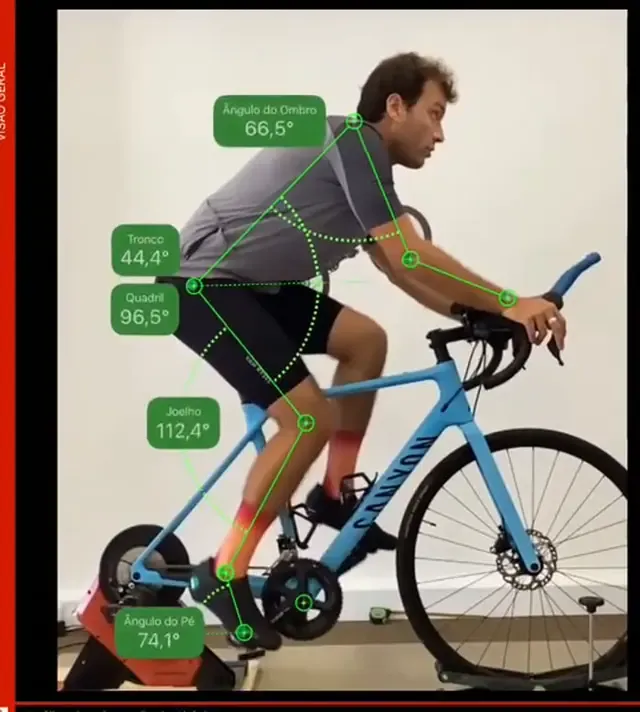
A road cyclist with burning under the foot from the first hour onwards. The cleats were very far forward and the support fell almost on the toes. On video, the ankle was working a lot at the lowest point of the pedal stroke.
I moved the cleats back a few millimetres, marked the new position and filmed again. I checked the saddle height, because the foot had changed place on the pedal. The cyclist came away with the measurements written down and the instruction to test on short rides before a long one.
What to do today
- Trace the outline of the cleats in pen before loosening any bolt.
- Check on the box or on the brand’s website whether your cleat has float and how much.
- Tighten the bolts again after the first ride with the new position.
When this gets measured
Where the cleat supports the foot decides where the load falls and how the knee goes up and down.
In the bike fit, at your home, I film the foot and the knee while you pedal on the trainer and use the laser line to see whether the knee follows the line of the foot. I adjust the cleats during the session itself, film again and check the saddle height.
If numbness or pain in the foot does not go away off the bike, see a doctor.
Frequently asked questions
How do you adjust cycling shoe cleats? Mark the current position, put the cleat under the head of the 1st metatarsal, set the rotation by the natural angle of the foot and test on a short ride. One adjustment at a time, and tighten the bolts again afterwards.
Does moving the cleats back give more performance? In the two studies that measured it, no: oxygen consumption did not change with the cleat further back (Van Sickle & Hull, 2007) and the cleat under the arch gave no substantial advantage (Paton, 2009). The adjustment serves the comfort of the foot and the alignment of the knee.
Are clipless pedals good for beginners? They can be, with a cleat with float and the pedal spring at the minimum. Practise releasing your foot with the bike stationary, leaning against a wall, before the first ride on the road.
Sources
- Van Sickle JR Jr, Hull ML. Is economy of competitive cyclists affected by the anterior-posterior foot position on the pedal? J Biomech. 2007;40(6):1262-7. DOI 10.1016/j.jbiomech.2006.05.026 · PMID 16901493 — https://pubmed.ncbi.nlm.nih.gov/16901493/
- Paton CD. Effects of shoe cleat position on physiology and performance of competitive cyclists. Int J Sports Physiol Perform. 2009;4(4):517-23. DOI 10.1123/ijspp.4.4.517 · PMID 20029102 — https://pubmed.ncbi.nlm.nih.gov/20029102/
- Ruby P, Hull ML. Response of intersegmental knee loads to foot/pedal platform degrees of freedom in cycling. J Biomech. 1993;26(11):1327-40. DOI 10.1016/0021-9290(93)90356-j · PMID 8262994 — https://pubmed.ncbi.nlm.nih.gov/8262994/
- Sanderson DJ, Hennig EM, Black AH. The influence of cadence and power output on force application and in-shoe pressure distribution during cycling by competitive and recreational cyclists. J Sports Sci. 2000;18(3):173-81. DOI 10.1080/026404100365072 · PMID 10737268 — https://pubmed.ncbi.nlm.nih.gov/10737268/