
Blog · · updated 23 November 2026
Saddle height: 3 methods that disagree and how to check
Saddle height: the heel method, the inseam (inside leg) formula and the knee angle. Why they disagree and how to check on video. Lisbon, Portugal.
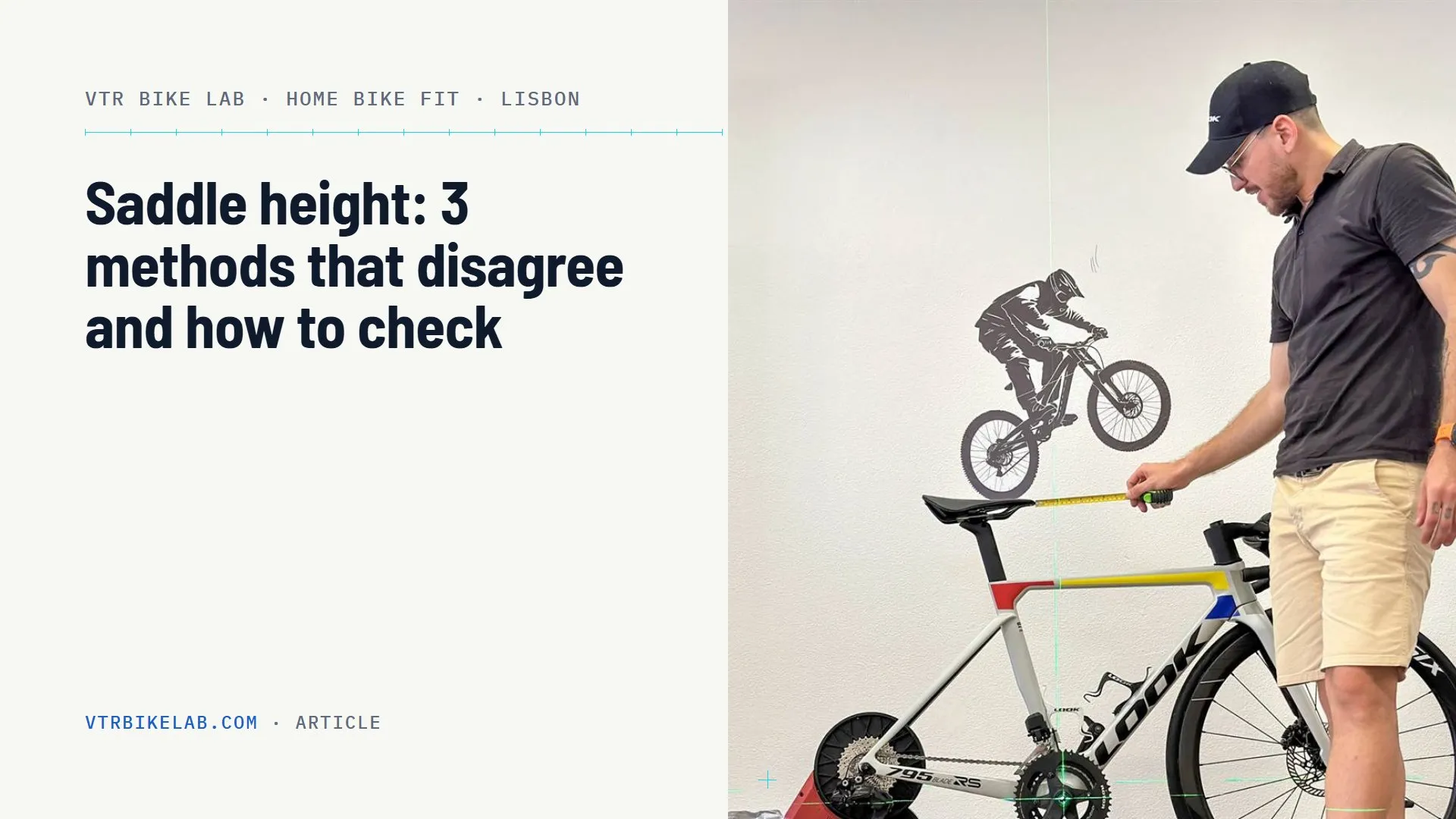
Short answer: For saddle height there are three methods: the heel method, the inseam formula (0.883 × inseam or 109% of inseam) and the knee angle, 25–35° of flexion measured stationary (Holmes, 1994) or 30–40° on video (Ferrer-Roca, 2012). The formula and the angle do not give the same height (Peveler, 2008). The formula serves as a starting point; the final height is confirmed by watching the pedal stroke, on video.
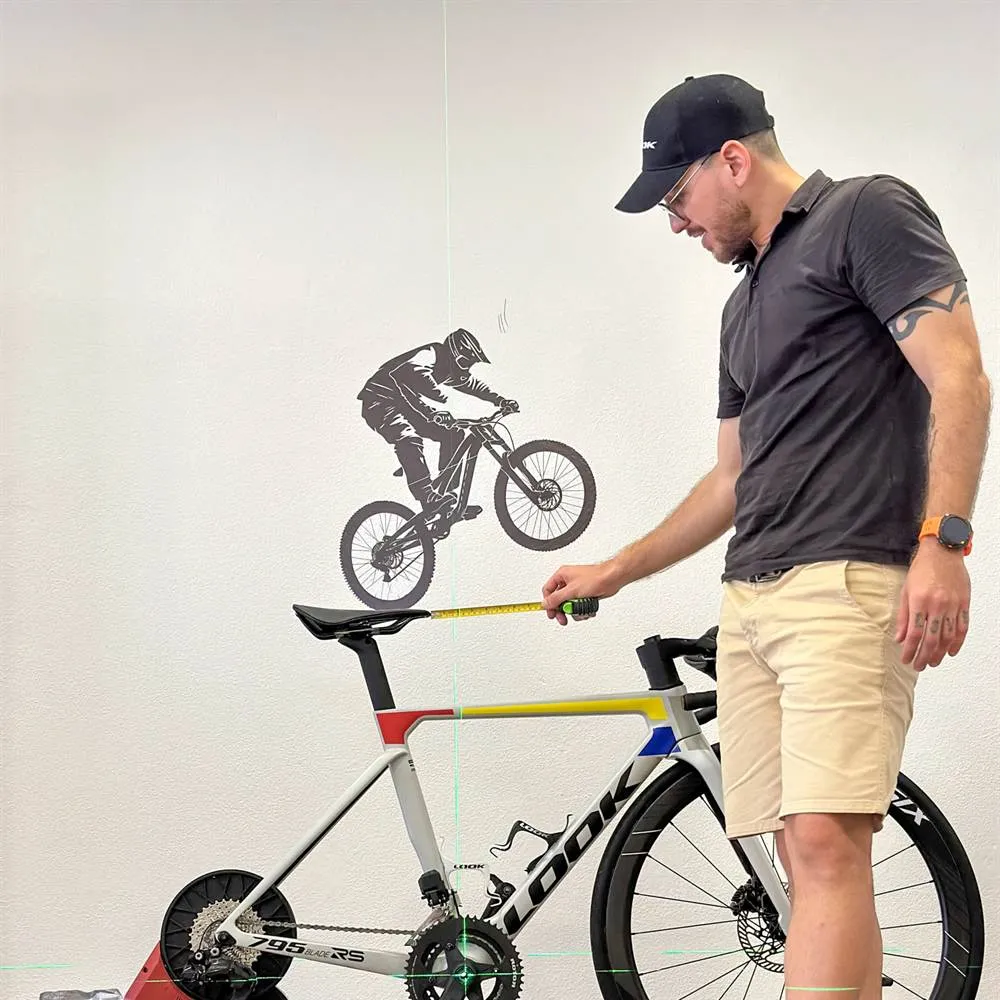
Saddle height by inside leg: how is it measured?
The “inside leg” is the inseam: the distance from the floor to the crotch, barefoot. It is the basis of the formulas.
- Barefoot, back against the wall, feet hip-width apart.
- A book between your legs, spine upwards, pulled up firmly.
- Mark the top of the book’s spine on the wall and measure down to the floor.
- Repeat three times and use the average.
Saddle height is measured from the centre of the bottom bracket axle to the top of the saddle, along the seat tube.
The 3 methods: how do they work and why do they disagree?
| Method | How it is done | Limitation |
|---|---|---|
| Heel | heel on the pedal at the bottom, leg straight | depends on your footwear and on how you sit |
| Inseam formula | 0.883 × inseam (LeMond) or 109% of inseam (Hamley), reviewed by Bini (2011) | uses only the inseam: ignores the foot, the ankle and flexibility |
| Knee angle | 25–35° stationary, with a goniometer (Holmes, 1994); 30–40° on video (Ferrer-Roca, 2012) | requires measuring |
Peveler (2008) compared 25°, 35° and 109% of inseam in 15 people, 10 of them non-cyclists: oxygen consumption was lower at 25°. The paper notes that the knee angle and the 109% formula do not give similar heights.
In well-trained cyclists, 56.5% had the saddle outside the range of 106–109% of inseam, and that range did not guarantee 30–40° of flexion while pedalling (Ferrer-Roca, 2012).
Does saddle height make a difference?
It does. In most of the studies reviewed by Bini (2011), changing saddle height by 5% altered knee kinematics by 35%.
| Sign | Saddle is probably |
|---|---|
| Hips rocking from side to side | high |
| Foot pointing well down at the bottom of the pedal stroke | high |
| Knee very bent at the bottom, above 40° on video | low |
| Feeling of pedalling cramped | low |
With a lower saddle, the force on the kneecap tends to rise (Bini, 2011).
How do you check saddle height while pedalling?
By filming. From static to pedalling, the foot points further down and knee flexion increases; the change appears greater in novices (Peveler, 2012). The stationary number is only the start.
- Bike on the turbo trainer, phone side-on, at bottom bracket height.
- Pedal for a few minutes at your normal pace.
- Pause with the pedal at the bottom: the leg is never fully straight.
- On the road and on the mountain bike it is the same; with a dropper post, measure with it fully up.
A concrete example
Think of someone with an 82 cm inseam. LeMond’s formula gives 72.4 cm from the bottom bracket axle to the top of the saddle (0.883 × 82). You set the saddle there and film on the trainer.
If, on video, knee flexion at the bottom is below 30°, the saddle is high for you. You go down a few millimetres, film again and repeat until you are within 30–40°. The formula gave the starting point; the video gave the measurement.
What to do today
- Measure your inseam three times and work out 0.883 × inseam.
- Compare it with the current height of your saddle and note the difference.
- If you move it, change a few millimetres at a time and film.
When this gets measured
Saddle height is the first adjustment I check when the knee complains.
In the bike fit, at your home, I measure it stationary and confirm it on video on the trainer, at an easy pace and at a hard pace, always stating the method. I adjust during the session itself and the measurement goes in the report.
If knee pain does not go away, swells or comes with loss of strength, see a doctor.
Frequently asked questions
Does saddle height make a difference? It does. In most of the studies reviewed, changing saddle height by 5% altered knee kinematics by 35% (Bini, 2011). So measure, note it down and change a little at a time.
How do you calculate saddle height from your inside leg? Measure your inseam barefoot, with a book between your legs, and multiply by 0.883: that gives the height from the bottom bracket axle to the top of the saddle (LeMond). It is a starting point; confirm on video, with 30–40° of flexion (Ferrer-Roca, 2012).
Is mountain bike saddle height the same as on the road? The method is the same. On the mountain bike, measure with the dropper post fully up and measure again if you change shoes or pedals, because the sole and the pedal change the distance to the foot.
Sources
- Holmes JC, Pruitt AL, Whalen NJ. Lower extremity overuse in bicycling. Clin Sports Med. 1994;13(1):187-205. PMID 8111852 — https://pubmed.ncbi.nlm.nih.gov/8111852/
- Ferrer-Roca V, Roig A, Galilea P, García-López J. Influence of saddle height on lower limb kinematics in well-trained cyclists: static vs. dynamic evaluation in bike fitting. J Strength Cond Res. 2012;26(11):3025-9. DOI 10.1519/JSC.0b013e318245c09d · PMID 22190163 — https://pubmed.ncbi.nlm.nih.gov/22190163/
- Peveler WW. Effects of saddle height on economy in cycling. J Strength Cond Res. 2008;22(4):1355-9. DOI 10.1519/JSC.0b013e318173dac6 · PMID 18545167 — https://pubmed.ncbi.nlm.nih.gov/18545167/
- Peveler WW, Shew B, Johnson S, Palmer TG. A kinematic comparison of alterations to knee and ankle angles from resting measures to active pedaling during a graded exercise protocol. J Strength Cond Res. 2012;26(11):3004-9. DOI 10.1519/JSC.0b013e318243fdcb · PMID 22158094 — https://pubmed.ncbi.nlm.nih.gov/22158094/
- Bini R, Hume PA, Croft JL. Effects of bicycle saddle height on knee injury risk and cycling performance. Sports Med. 2011;41(6):463-76. DOI 10.2165/11588740-000000000-00000 · PMID 21615188 — https://pubmed.ncbi.nlm.nih.gov/21615188/