
Blog · · updated 23 November 2026
Foot pain when cycling: burning, numbness, what to adjust
Foot pain when cycling, burning or a numb foot? Where pressure concentrates, what shoes and cleats do, and when to see a doctor. Bike fit in Lisbon.
Short answer: Foot pain when cycling, with burning or numbness in the sole, is associated with pressure at the front of the foot. In the cyclists studied, the areas with the most load were the 1st metatarsal and the big toe (Sanderson, 2000). Cleat position changes where that load falls; shoe tightness and stiffness add to it. In the bike fit I film the foot while you pedal and adjust the cleat in the session. With numbness that does not go away, see a doctor.
Foot pain when cycling: what could it be?
The type of complaint gives the first clue. Research here is scarce, so the table is what I check in the bike fit, not a diagnosis.
| What you feel | Where | What I check first |
|---|---|---|
| Burning under the sole | front part of the foot, behind the toes | shoe tightness, cleat position, sole stiffness |
| Numb toes | toes, especially at the end of the ride | shoe tightness and width in the toe area |
| Pain in the arch or the heel | middle of the foot, heel | support of the foot inside the shoe, insole |
| Pain on the outer side of the foot | outer edge | rotation and side-to-side position of the cleat |
Numb foot in cycling: why does it happen?
Because the force of the pedal stroke always passes through the same point of the foot. In 29 cyclists, recreational and competitive, the structures that received the most load were the 1st metatarsal and the big toe (Sanderson, 2000).
- The pattern was similar in the two groups: it reflected the relationship between the foot, the shoe and the pedal, not training (Sanderson, 2000).
- Carbon-soled shoes, which are stiffer, gave peak pressures at the front of the foot 18% higher than plastic-soled ones (Jarboe & Quesada, 2003).
The sole study was done at 400 W, a high load. It shows a tendency, not what you will feel on an easy ride.
Tight cycling shoes: can they cause numbness?
They can, and it is one of the first things I look at. A tight or narrow shoe adds the pressure of the pedal stroke to the pressure from the sides.
- Tighten enough that the heel does not come out, not so much that the foot can no longer move.
- If after an hour the shoe feels tighter than at the start, loosen it one notch.
- Try thinner socks before you change shoes.
- Check the width: a wide foot in a narrow shoe is compressed from the sides.
Shoe cleats: does position change foot pain?
It can change where the load falls. Moving the foot on the pedal, with the cleat set back almost to the middle of the foot, did not alter oxygen consumption in 11 competitive cyclists (Van Sickle & Hull, 2007).
- Cleat very far forward: the support falls near the toes.
- Cleat further back: the support moves to the middle of the foot.
- Different cleats on the two feet: compare them, especially if only one hurts.
And the foot does not stay still: from static to pedalling, it points further down and that changes the knee angle; in 34 cyclists, the variation seemed greater in novices (Peveler, 2012). That is why I assess the foot while pedalling, not just stationary.
A concrete example
A cyclist with burning in the sole of the right foot from the first hour onwards, on rides in the heat. New shoes, carbon-soled, tightened to the maximum. On video, the cleat was in front of the head of the 1st metatarsal.
I moved the cleat back a few millimetres, aligned it with the one on the other foot and checked the saddle height. I also asked the rider to tighten the front part of the shoe less. The rider left with the measurement written down and the advice to test it on short rides.
What to do today
- Loosen the front part of the shoe and keep the heel firm.
- Mark the position of the cleats and see whether they are the same on both feet.
- On long rides, move your toes and stand up out of the saddle from time to time, to relieve the foot.
When this gets measured
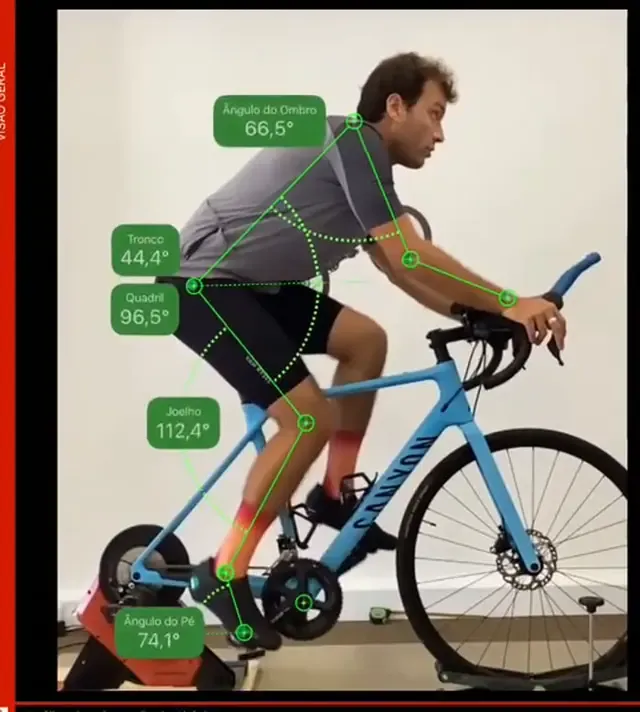
Cleat position and shoe tightness are what most change the pressure under the foot. In the bike fit, at your home, I film the foot while you pedal on the trainer, look at where the cleat is in relation to the 1st metatarsal and check the saddle height after any change. I adjust in the session itself and film again.
A bike fit does not diagnose or treat: with numbness that does not go away off the bike, pain at rest, swelling or a change in sensation, see a doctor.
Frequently asked questions
Foot pain after cycling: is it normal? Some tiredness, yes. Burning, numbness or pain that lasts for hours after the ride, no. Check the shoe tightness and the cleat position. If the pain stays at rest, if there is swelling or the sensation changes, see a doctor.
Numb foot in cycling: why does it happen? Pressure concentrates at the front of the foot, mainly in the area of the 1st metatarsal and the big toe (Sanderson, 2000). Tight shoes, a stiff sole and a cleat very far forward are what I check first.
What is the cleat position on the shoe? The usual starting point is the cleat under the head of the 1st metatarsal, the bump at the base of the big toe. From there it is adjusted for the comfort of the foot and the line of the knee, one step at a time.
Sources
- Sanderson DJ, Hennig EM, Black AH. The influence of cadence and power output on force application and in-shoe pressure distribution during cycling by competitive and recreational cyclists. J Sports Sci. 2000;18(3):173-81. DOI 10.1080/026404100365072 · PMID 10737268 — https://pubmed.ncbi.nlm.nih.gov/10737268/
- Jarboe NE, Quesada PM. The effects of cycling shoe stiffness on forefoot pressure. Foot Ankle Int. 2003;24(10):784-8. DOI 10.1177/107110070302401009 · PMID 14587994 — https://pubmed.ncbi.nlm.nih.gov/14587994/
- Van Sickle JR Jr, Hull ML. Is economy of competitive cyclists affected by the anterior-posterior foot position on the pedal? J Biomech. 2007;40(6):1262-7. DOI 10.1016/j.jbiomech.2006.05.026 · PMID 16901493 — https://pubmed.ncbi.nlm.nih.gov/16901493/
- Peveler WW, Shew B, Johnson S, Palmer TG. A kinematic comparison of alterations to knee and ankle angles from resting measures to active pedaling during a graded exercise protocol. J Strength Cond Res. 2012;26(11):3004-9. DOI 10.1519/JSC.0b013e318243fdcb · PMID 22158094 — https://pubmed.ncbi.nlm.nih.gov/22158094/