
Blog · · updated 23 November 2026
FTP and watts in cycling: what they are, do you need them
FTP in cycling: what it means, how to calculate it, what watts per kilo are and when a power meter makes sense for an amateur. Written in Lisbon.
Short answer: In cycling, FTP is, by the convention of training with power, the highest power you can hold for about an hour, measured in watts. It is used to calculate training zones. For anyone just starting out it is not essential: perceived effort and heart rate are enough to organise the first months. A power meter makes sense when you already train regularly and want exact intensities.
FTP in cycling: what does it mean?
FTP stands for Functional Threshold Power. It is a convention used by people who train with power, not a laboratory value: the power you can hold for about an hour in a continuous effort.
| Term | What it is |
|---|---|
| Watt (W) | unit of power: the force on the pedals times the speed at which they turn |
| FTP | the power you can hold for about an hour (convention) |
| W/kg | your FTP divided by your weight |
| Power zones | intensity ranges calculated from your FTP |
How do you calculate FTP in cycling?
You need something that measures watts: a power meter on the bike or a smart turbo trainer. Then there are three routes:
- An effort of about an hour, at the maximum you can sustain. That is the definition, but it is hard.
- A shorter test with the app’s conversion. Practical, but it is an estimate.
- An automatic estimate from the bike computer, based on your rides.
Any number that comes out of this is a starting point. To compare, repeat the test under the same conditions: same trainer, same time of day, same level of tiredness.
Watts per kilo: what is it for?
For comparing efforts when weight counts, especially when climbing. The sum is simple: W/kg = FTP ÷ weight in kilos.
- On a climb, W/kg matters more: you carry your weight and the bike’s against gravity.
- On the flat, total power and air resistance matter more.
- For you, W/kg is only useful compared with yourself, from test to test.
Power meter: is it worth it for an amateur?
It depends on the stage you are at.
| It makes sense when | It does not make sense yet when |
|---|---|
| you already train regularly and want exact intensities | you are in the first months and still building the habit |
| you train a lot on a smart trainer, which already measures watts | the budget competes with a helmet, lights and a bike that fits you |
| you have an event and a plan with zones | what holds you back is pain when pedalling: watts do not explain it |
Without a power meter, how do I train by intensity?
With perceived effort and heart rate. You don’t need more than that to start.
| Tool | What it tells you |
|---|---|
| Perceived effort | whether you can say whole sentences or only single words |
| Heart rate | the intensity on the inside; the estimated maximum is 208 − 0.7 × age (Tanaka, 2001) |
| Power | the work you are doing, in watts, with no delay |
Tanaka’s formula (2001) is a starting point: the old “220 − age” formula underestimated the maximum in older people, and the variation from person to person remains large.
Whatever the tool, most sessions can be easy. In endurance athletes at national and international level, about 80% of sessions are at low intensity and about 20% include intense work (Seiler, 2010).
A concrete example
A cyclist who bought a smart trainer and did the FTP test in the first week, tired after a day’s work. He was discouraged by the number and started training every day “in the zones”, almost always hard.
I asked him to repeat the test on the same trainer, at the same time of day and rested, and to keep the first value only as a starting point. Then we reorganised the week: most sessions easy and a few hard, as Seiler (2010) describes. The number that counts is his own, compared with himself.
What to do today
- If you don’t have a power meter, train by feel and by heart rate.
- If you have one, do a test and write down the conditions in which you did it.
- Calculate your W/kg only to compare yourself with yourself, not with others.
When to ask for help
- Coach: to turn FTP into zones and the zones into a plan.
- Doctor: before maximal tests if you have heart disease, or if you feel chest pain, dizziness or unusual shortness of breath during effort.
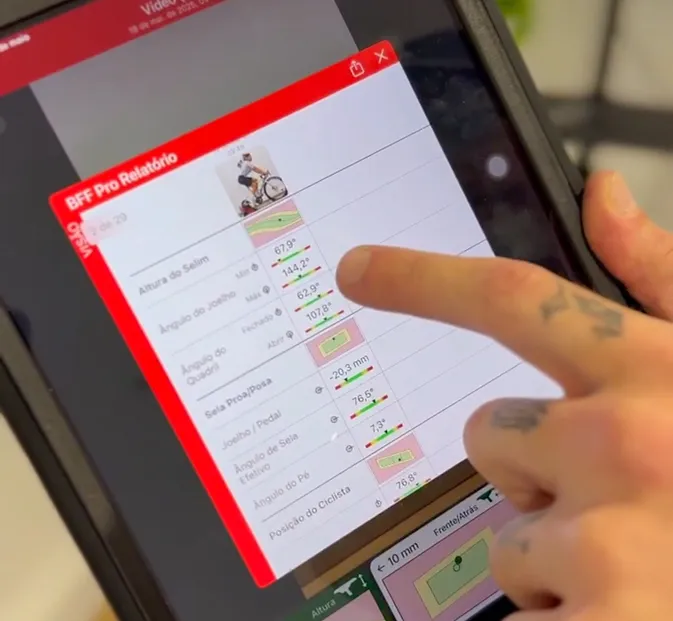
- Position measurement: discomfort that always comes back to the same place, or forces you to stop before the end of the effort, is something to measure, in addition to reviewing your training. Watts do not explain it.
Frequently asked questions
What does FTP mean in cycling? It is the highest power you can hold for about an hour, in watts. It is a convention of training with power, used to calculate zones. It is not a laboratory measurement nor a fixed value: it changes with training, rest and the test itself.
What is a good FTP for an amateur cyclist? I don’t give reference numbers: FTP varies with age, weight, sex, years of training and the type of test. Compare your FTP with yourself, from test to test, under the same conditions. That is where you see whether you are improving.
How do you calculate watts per kilo? Divide your FTP, in watts, by your weight in kilos. The result is power per kilo. It counts above all on the climbs. On the flat, total power and air resistance matter more.
Sources
- Seiler S. What is best practice for training intensity and duration distribution in endurance athletes? Int J Sports Physiol Perform. 2010;5(3):276-91. DOI 10.1123/ijspp.5.3.276 · PMID 20861519 — https://pubmed.ncbi.nlm.nih.gov/20861519/
- Tanaka H, Monahan KD, Seals DR. Age-predicted maximal heart rate revisited. J Am Coll Cardiol. 2001;37(1):153-6. DOI 10.1016/s0735-1097(00)01054-8 · PMID 11153730 — https://pubmed.ncbi.nlm.nih.gov/11153730/
- FTP (Functional Threshold Power): a convention of training with power (the power you can sustain for about an hour). No PMID: it is a definition in common use, not a study result.