
Blog ·
How many km to ride: load, progression and overtraining
How many km to ride per day or per week? Why km mislead, how to raise the load gradually, how to recover and which signs say ease off. Lisbon, Portugal.
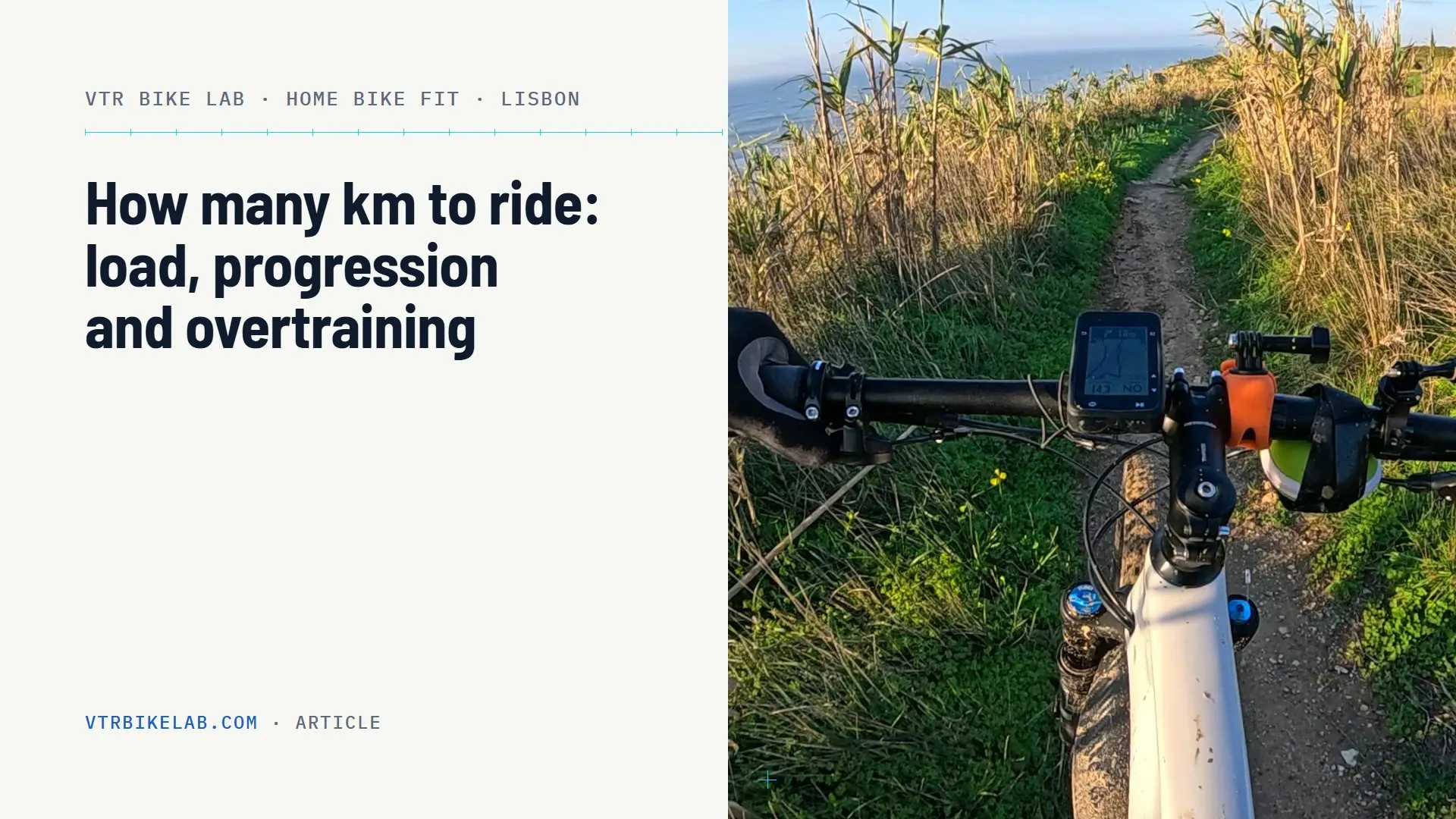
Short answer: How many km should you ride? There is no right number for everyone. For someone starting out, raising the load slowly matters more than hitting a target: large, rapid increases in load were associated with a large share of non-contact injuries, and training too little can also increase the risk (Gabbett, 2016). Progress by time on the bike and by how you feel, not by kilometres.
How many km to ride per day or per week?
Kilometres mislead: 30 km on the flat with a tailwind are not 30 km uphill. There are better measures of load:
| Measure | Why it works |
|---|---|
| Time spent riding | it counts the same on the flat, on a climb and on the turbo trainer |
| Session effort rating × minutes | combines duration and intensity in a single number (Foster, 1998) |
| Kilometres | they only compare similar rides |
Give each ride an effort rating, from very easy to maximal, and multiply it by the minutes. Add up the week and compare it with the previous one.
How many km to ride as a beginner?
As many as you can repeat without ending up wrecked. Then build up gradually:
- Raise one thing at a time: the duration, the intensity or the number of rides.
- After raising it, hold that level for a while before raising it again.
- Alternate hard days and easy days.
- Don’t compare your week with that of someone who has been riding for years.
And the famous rule of not increasing by more than 10% a week? In a trial with 532 novice runners, a gradual 13-week programme based on it had 20.8% injuries, against 20.3% in a standard 8-week programme (Buist, 2008). It was running, not cycling, but the rule did not protect.
Recovery in cycling: how much rest do I need?
As much as it takes for you to reach the next session with the will and the legs for it. There is no time frame that suits everyone. The European and American consensus sums it up like this: training well requires overload, but avoid the combination of excessive overload with insufficient recovery (Meeusen, 2013).
| What helps | Why |
|---|---|
| Easy days between the hard ones | in 25 experienced athletes, minor illnesses appeared mostly when an individual threshold of load and monotony was exceeded (Foster, 1998) |
| Active recovery | riding very easy, with no effort |
| Sleeping and eating enough | recovery happens off the bike |
Overtraining in cycling: what are the signs?
The signs are non-specific, and no single marker is accepted for detecting it (Meeusen, 2013). Be suspicious when several come together:
- Tiredness that does not go away with easy days.
- Performance going down, even though you are training more.
- Low mood or irritability.
- More frequent colds and minor ailments (Foster, 1998).
Overtraining is diagnosed by exclusion: first, illnesses, infections and a lack of energy in the diet are ruled out (Meeusen, 2013).
If I stop for a few weeks, do I lose everything?
You don’t lose everything, but you do lose some. Without training, the muscle gradually loses its endurance adaptations, while strength usually holds for longer. In people who have been training for only a short time, the adaptations tend to return to the starting point (Mujika & Padilla, 2001).
A concrete example
A cyclist just starting out who, in the same month, went from two short rides a week to four, one of them long. Soon afterwards their legs were always heavy and they had pain at the front of the knee. As there was pain, I measured the position on the trainer first: the saddle was low and I adjusted it in the session.
On top of that, we rebuilt the week: time instead of kilometres, one increase in load at a time, easy days between the hard ones. Poorly dosed training on top of a poorly adjusted position is the perfect pair for aches and injuries, so we worked on both.
What to do today
- Write down last week in minutes, not in kilometres.
- Give each ride an effort rating and multiply it by the minutes.
- Plan next week with hard and easy days alternating.
When to ask for help
- Coach: if you want to progress with a plan.
- Doctor: tiredness that does not go away with rest, unexplained drops in performance, repeated illnesses.
- Nutritionist: if you eat too little for the amount you train.
- Position measurement: pain that always comes back in the same place when the load goes up gets measured, as well as reviewing the load.
Frequently asked questions
How many km should I ride per day? There is no right number. Start with the time you can repeat without ending up wrecked and build up gradually, one thing at a time. Large, rapid increases in load were associated with more injuries (Gabbett, 2016).
Can I ride every day? You can, if most days are easy and if you alternate hard days with easy days. In experienced athletes, minor illnesses appeared mostly when an individual threshold of load and monotony was exceeded (Foster, 1998). If tiredness builds up, ease off.
What is active recovery in cycling? It is riding very easy, in an easy gear, with no effort, on the day after a hard session. It is for moving your legs without adding load. If even that doesn’t feel good, rest.
Sources
- Gabbett TJ. The training-injury prevention paradox: should athletes be training smarter and harder? Br J Sports Med. 2016;50(5):273-80. DOI 10.1136/bjsports-2015-095788 · PMID 26758673 — https://pubmed.ncbi.nlm.nih.gov/26758673/
- Foster C. Monitoring training in athletes with reference to overtraining syndrome. Med Sci Sports Exerc. 1998;30(7):1164-8. DOI 10.1097/00005768-199807000-00023 · PMID 9662690 — https://pubmed.ncbi.nlm.nih.gov/9662690/
- Meeusen R et al. Prevention, diagnosis, and treatment of the overtraining syndrome: joint consensus statement of the European College of Sport Science and the American College of Sports Medicine. Med Sci Sports Exerc. 2013;45(1):186-205. DOI 10.1249/MSS.0b013e318279a10a · PMID 23247672 — https://pubmed.ncbi.nlm.nih.gov/23247672/
- Buist I et al. No effect of a graded training program on the number of running-related injuries in novice runners: a randomized controlled trial. Am J Sports Med. 2008;36(1):33-9. DOI 10.1177/0363546507307505 · PMID 17940147 — https://pubmed.ncbi.nlm.nih.gov/17940147/
- Mujika I, Padilla S. Muscular characteristics of detraining in humans. Med Sci Sports Exerc. 2001;33(8):1297-303. DOI 10.1097/00005768-200108000-00009 · PMID 11474330 — https://pubmed.ncbi.nlm.nih.gov/11474330/