
Blog · · updated 23 November 2026
How to start cycling: the first 1,000 km
How to start cycling: which bike, what pace to ride in the first 1,000 km, how to build load and what the law says on helmets and lights.
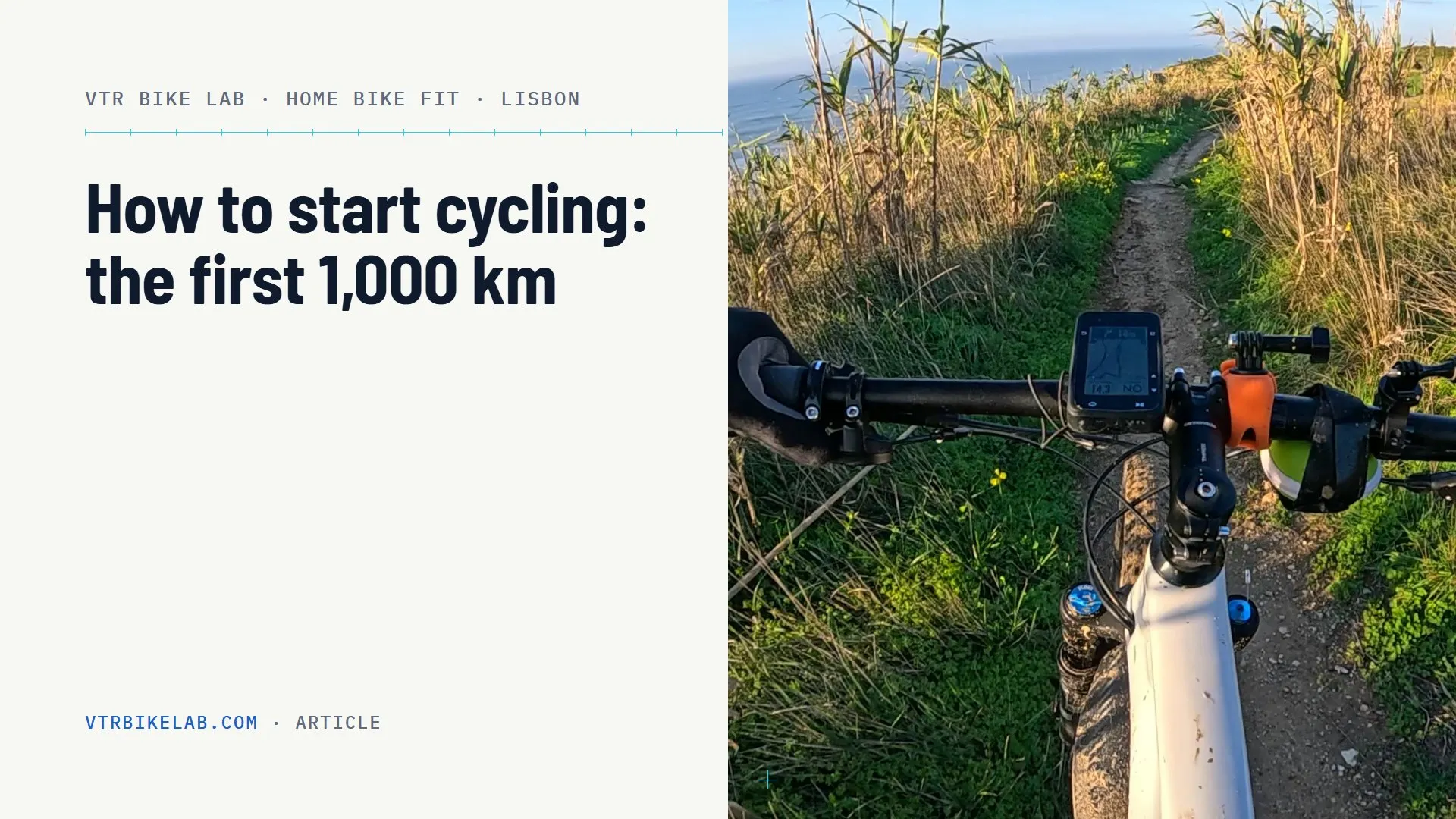
Short answer: To start cycling you need a bike in your size, lights and water, and to ride slowly almost all the time. In the endurance athletes studied, about 80% of sessions are at low intensity (Seiler, 2010). Increase the load little by little: rapid, large increases are associated with more injuries (Gabbett, 2016). In return, you gain cardiorespiratory fitness (Oja, 2011).
How do you start cycling?
With a bike that fits you, a simple routine and patience with the load. Split the first 1,000 km into three stages:
| Stage | What to learn | How to ride |
|---|---|---|
| 0 to 200 km | gears, brakes, drinking while riding, setting off and stopping safely | short rides, on flat ground |
| 200 to 500 km | a fixed routine during the week, eating on the longer rides | almost all of it slowly, able to hold a conversation |
| 500 to 1,000 km | first long ride, riding in a group, climbs | one harder block per week |
What you gain has been measured. In a review of 16 studies, the evidence was strong for cardiorespiratory fitness and moderate for cardiovascular risk factors (Oja, 2011). For weight, it was inconclusive: I won’t promise you kilos.
A bike for a beginner cyclist: which one to choose?
The one that fits you. Size comes before the model, and where you are going to ride comes before the purchase.
- Frame size: you can stand over it and reach the handlebar without stretching your arms.
- Type: road for tarmac, mountain bike (MTB) for trails, gravel if you want a bit of both.
- Pedals: start with flat pedals; clipless pedals come later.
- Saddle: at the right height before the first ride, not after the first pain.
Cycling: tips for beginners on your first rides
Ride slowly. It may not seem like much, but this is how endurance athletes train: in those at national and international level, about 80% of sessions are at low intensity (Seiler, 2010).
- Talk test: if you can speak in full sentences, you are at the right pace for almost every ride.
- Duration before intensity: first you ride for longer, only then harder.
- Small increases in load: excessive and rapid increases are associated with a large share of non-contact injuries; training too little can also increase the risk (Gabbett, 2016).
- Food and water: always carry water and, on the longer rides, something to eat.
How to start road cycling: what does the law say?
On the road, the rules are those of the Código da Estrada (the Portuguese Highway Code). The essentials for anyone starting out:
- Helmet: it is not compulsory for anyone riding a bicycle; Article 82 only requires it on mopeds, motorcycles, tricycles and quadricycles. I always recommend one.
- Lights and reflectors: lights from dusk to dawn and whenever visibility is insufficient; reflectors, always (Código da Estrada, Articles 61 and 93; Portaria 311-B/2005, a ministerial order).
- The rest: the detail is in the article on helmets and lights, linked at the end of this page.
A concrete example
A cyclist just starting out, with a road bike bought second-hand. In the first week they did two two-hour rides, flat out the whole time. In the second, they had pain at the front of the knee and little desire to go back out.
First I measured the saddle height: it was low, and I raised it. Then I suggested three short rides a week, almost all at conversational pace, and one long ride growing slowly. They started noting down every ride: duration, how it felt and any pain.
What to do today
- Check your saddle height before your next ride.
- Do your next ride at a pace at which you can hold a conversation.
- Buy lights, front and rear, if you don’t have them yet.
When to ask for help
- Doctor: before you start, if you have a chronic condition or take medication for your heart or blood pressure; and straight away, if you have chest pain, unusual shortness of breath or dizziness while riding.
- Coach: if you want to prepare for an event or want a plan made to measure for you.
- Position measurement: if a pain comes back to the same place, or if you want to start out with the saddle and handlebar already adjusted to you. In a bike fit I measure your position while you pedal and adjust it in the same session.
Frequently asked questions
Cycling for beginners: how many km per week? There is no one right number for everyone. Start with time, not km: two or three short, easy rides a week, increasing the duration little by little. Rapid, large increases in load are associated with more injuries (Gabbett, 2016).
Is a helmet compulsory on a bicycle? In Portugal, no: the Código da Estrada (the Portuguese Highway Code) only requires it on mopeds, motorcycles, tricycles and quadricycles (Article 82). I always recommend one. At night, lights and reflectors on the bicycle are compulsory.
Does cycling help you lose weight? The evidence is strong for cardiorespiratory fitness, but inconclusive for excess weight (Oja, 2011). Cycling uses energy, but I won’t promise you kilos: your diet and the rest of your routine count too.
Sources
- Oja P, Titze S, Bauman A, de Geus B, Krenn P, Reger-Nash B, Kohlberger T. Health benefits of cycling: a systematic review. Scand J Med Sci Sports. 2011;21(4):496-509. DOI 10.1111/j.1600-0838.2011.01299.x · PMID 21496106 — https://pubmed.ncbi.nlm.nih.gov/21496106/
- Seiler S. What is best practice for training intensity and duration distribution in endurance athletes? Int J Sports Physiol Perform. 2010;5(3):276-91. DOI 10.1123/ijspp.5.3.276 · PMID 20861519 — https://pubmed.ncbi.nlm.nih.gov/20861519/
- Gabbett TJ. The training-injury prevention paradox: should athletes be training smarter and harder? Br J Sports Med. 2016;50(5):273-80. DOI 10.1136/bjsports-2015-095788 · PMID 26758673 — https://pubmed.ncbi.nlm.nih.gov/26758673/
- Código da Estrada (versão consolidada), art. 61.º, 82.º e 93.º; Portaria n.º 311-B/2005. Procuradoria-Geral Distrital de Lisboa — https://www.pgdlisboa.pt/leis/lei_mostra_articulado.php?nid=349 (Portuguese Highway Code, consolidated version, Articles 61, 82 and 93; Ministerial Order No. 311-B/2005.)