
Blog · · updated 23 November 2026
Turbo trainer: train indoors without pain or wasted time
Bike turbo trainer: which one to choose, why the saddle bothers you more, how much to drink and how to organise indoor sessions. Written in Lisbon.
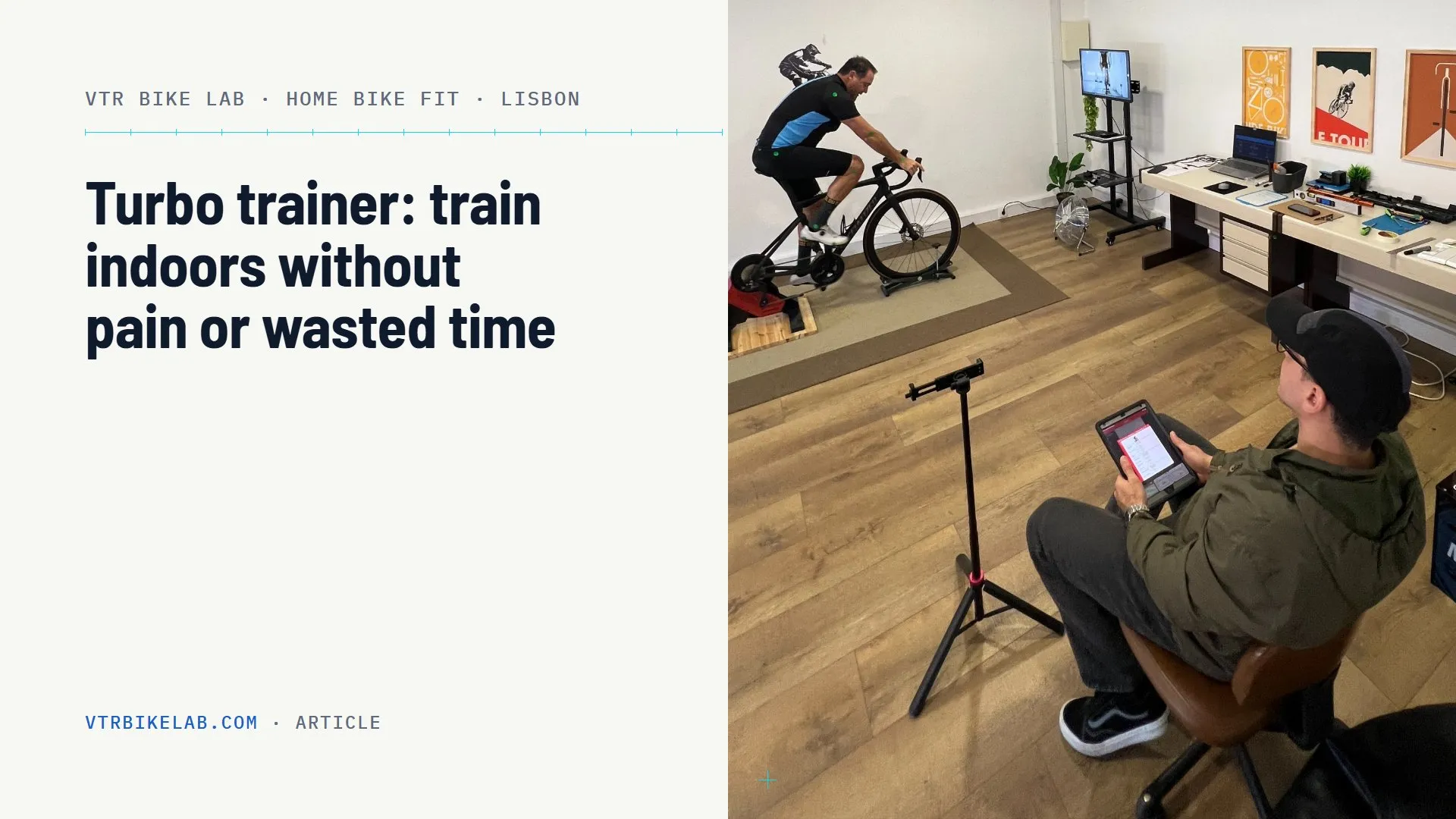
Short answer: On the turbo trainer, the bike never stops: there are no descents and no wind, so the saddle and the heat weigh on you more than on the road. Stand up on the pedals regularly, every 10 minutes according to one review (Litwinowicz, 2021), put a fan in front of you, drink to thirst and do most sessions at low intensity.
Turbo trainer: which one to choose?
It depends on what you want to do with it.
| Type | How it works | Who it’s for |
|---|---|---|
| Rollers | the bike sits loose on top of three rollers; it requires balance | those who want to train technique and balance |
| Wheel-on trainer | the rear wheel presses against a cylinder with resistance | starting out with a small investment |
| Direct-drive smart trainer | you take off the rear wheel; the trainer measures watts and adjusts the resistance | structured workouts and apps |
The smart trainer makes sessions less boring. The risk is turning every session into a race.
Why does the saddle bother you more on the trainer?
Because you are always seated, on the same spot of the saddle. In 46 healthy men, the oxygenation measured at the penis fell from 60.5 to 17.9 mmHg on sitting on the saddle and returned to normal after 10 minutes standing (Sommer, 2001).
- Stand up on the pedals: doing so every 10 minutes “may be effective”, according to a review with indirect evidence and in men only (Litwinowicz, 2021).
- Move your hands to a different place from time to time.
- Numbness that keeps coming back is not normal: it is a sign to look at the saddle and at the position.
How much to drink in a trainer session?
On the trainer there is no road wind to cool you down. Set up a fan and drink to thirst.
| When | What to do |
|---|---|
| Before | start hydrated, with your normal meals and water |
| During | 0.4 to 0.8 L per hour as a planning reference, adjusted to thirst (full text of the ACSM, 2007) |
| After | weigh yourself before and after to get to know how much you sweat (ACSM, 2007) |
Drinking well beyond thirst is not safer: the full text of the ACSM (2007) warns that drinking too much is also dangerous.
How to train on the trainer without wasting time?
With sessions that have a purpose, and most of them easy. In endurance athletes at national and international level, about 80% of sessions are at low intensity and about 20% include intense work (Seiler, 2010).
- Easy session: riding at a pace at which you can say whole sentences.
- Block session: warm up, a few hard blocks with recovery between them, cool down.
- Technique session: varying the cadence with different gears.
Choose the session before you get on the bike. Deciding once you are on the trainer usually ends in “a little bit of everything”.
A concrete example
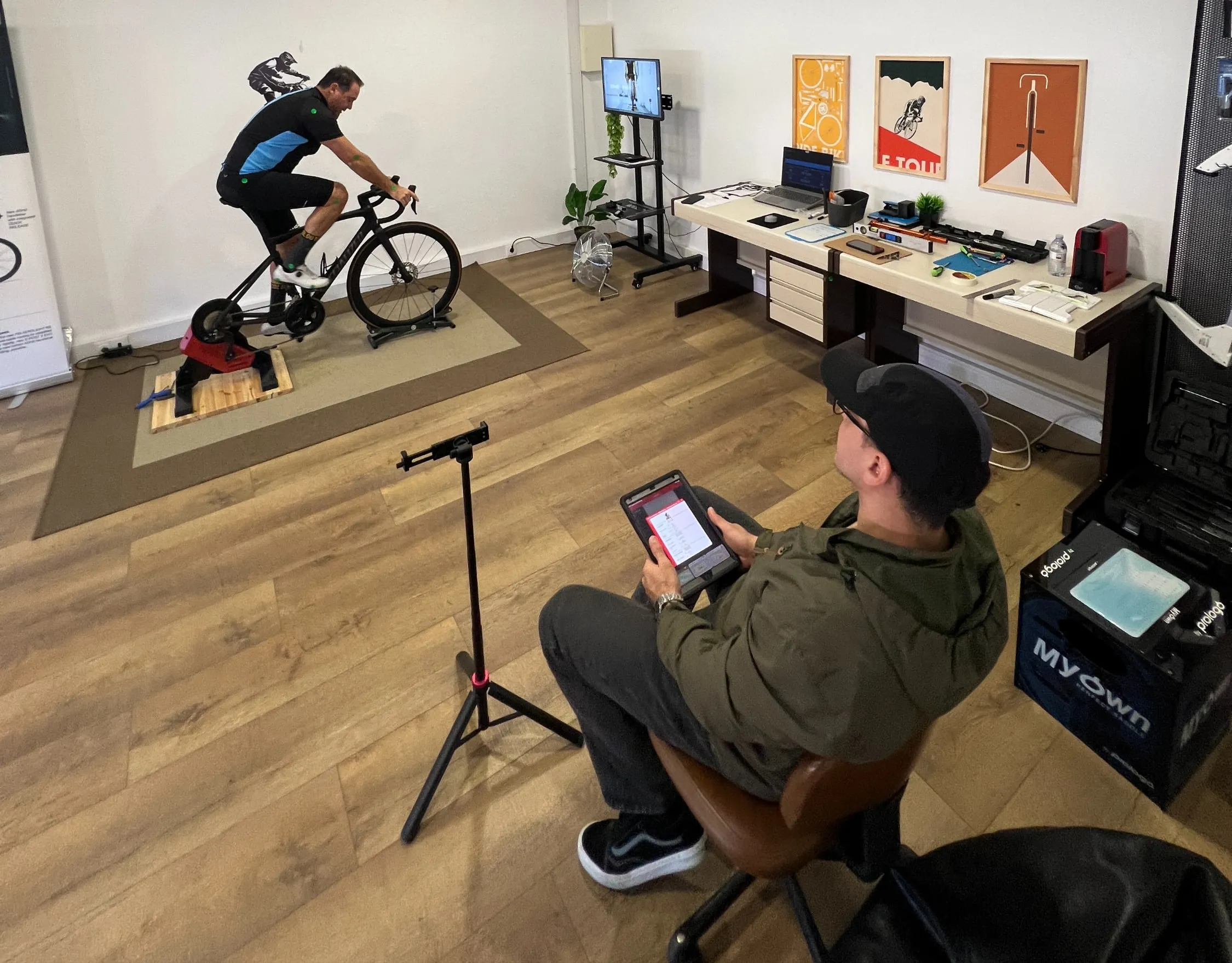
A cyclist who trained on the trainer all winter, with no fan and without getting up off the saddle, and finished the sessions with numbness and “cooked”. As there was numbness, I started with the position: I filmed him on the trainer and measured the saddle height and tilt and the shoulder angle.
I adjusted in the session what was out. On top of that, we agreed on three habits: standing up on the pedals every 10 minutes, a fan in front of him and a bottle within reach. He was to tell me, after a few sessions, whether the numbness came back.
What to do today
- Put a fan facing you before you start.
- Set a reminder to stand up on the pedals every 10 minutes.
- Weigh yourself before and after the next session to find out how much you sweat.
When to ask for help
- Coach: to put together the winter plan.
- Doctor: genital numbness that does not go away after you get off the bike, pain, urinary or erectile changes.
- Position measurement: numbness or pain that always comes back on the trainer gets measured, as well as reviewing the habits. It is on the trainer that I film and measure the pedal stroke: in the bike fit, at your home, the bike is mounted on your trainer or, if you don’t have one, on mine.
Frequently asked questions
Is a smart turbo trainer worth it? It is if you like structured workouts or apps: it measures watts and adjusts the resistance by itself. To start, a wheel-on trainer is enough. What counts most is consistency and keeping most sessions easy (Seiler, 2010).
Can I use a mountain bike on the turbo trainer? Yes, as long as the trainer is compatible with the bike’s axle and drivetrain. On wheel-on trainers, a knobbly mountain bike tyre is noisy and wears out quickly; many people use a slick tyre just for the trainer.
Is the trainer better than the road when it comes to the saddle? No study that I know of compares the two. In the laboratory, more oscillation at the saddle increased the pressure on the perineum (Sanford, 2018), and on the trainer there are no potholes. But you always pedal seated and on the same spot: stand up regularly.
Sources
- Litwinowicz K, Choroszy M, Wróbel A. Strategies for Reducing the Impact of Cycling on the Perineum in Healthy Males: Systematic Review and Meta-analysis. Sports Med. 2021;51(2):275-87. DOI 10.1007/s40279-020-01363-z · PMID 33074460 — https://pubmed.ncbi.nlm.nih.gov/33074460/
- Sommer F et al. Erectile dysfunction in cyclists. Is there any difference in penile blood flow during cycling in an upright versus a reclining position? Eur Urol. 2001;39(6):720-3. DOI 10.1159/000052533 · PMID 11464064 — https://pubmed.ncbi.nlm.nih.gov/11464064/
- Sanford T et al. Effect of Oscillation on Perineal Pressure in Cyclists: Implications for Micro-Trauma. Sex Med. 2018;6(3):239-47. DOI 10.1016/j.esxm.2018.05.002 · PMID 29936216 — https://pubmed.ncbi.nlm.nih.gov/29936216/
- American College of Sports Medicine; Sawka MN et al. Exercise and fluid replacement. Med Sci Sports Exerc. 2007;39(2):377-90. DOI 10.1249/mss.0b013e31802ca597 · PMID 17277604 — https://pubmed.ncbi.nlm.nih.gov/17277604/
- Seiler S. What is best practice for training intensity and duration distribution in endurance athletes? Int J Sports Physiol Perform. 2010;5(3):276-91. DOI 10.1123/ijspp.5.3.276 · PMID 20861519 — https://pubmed.ncbi.nlm.nih.gov/20861519/