
Blog · · updated 23 November 2026
Back pain when cycling: causes and what to do
Back pain after cycling? What studies associate with the handlebar, time spent pedalling and the back muscles. Bike fit in Lisbon.
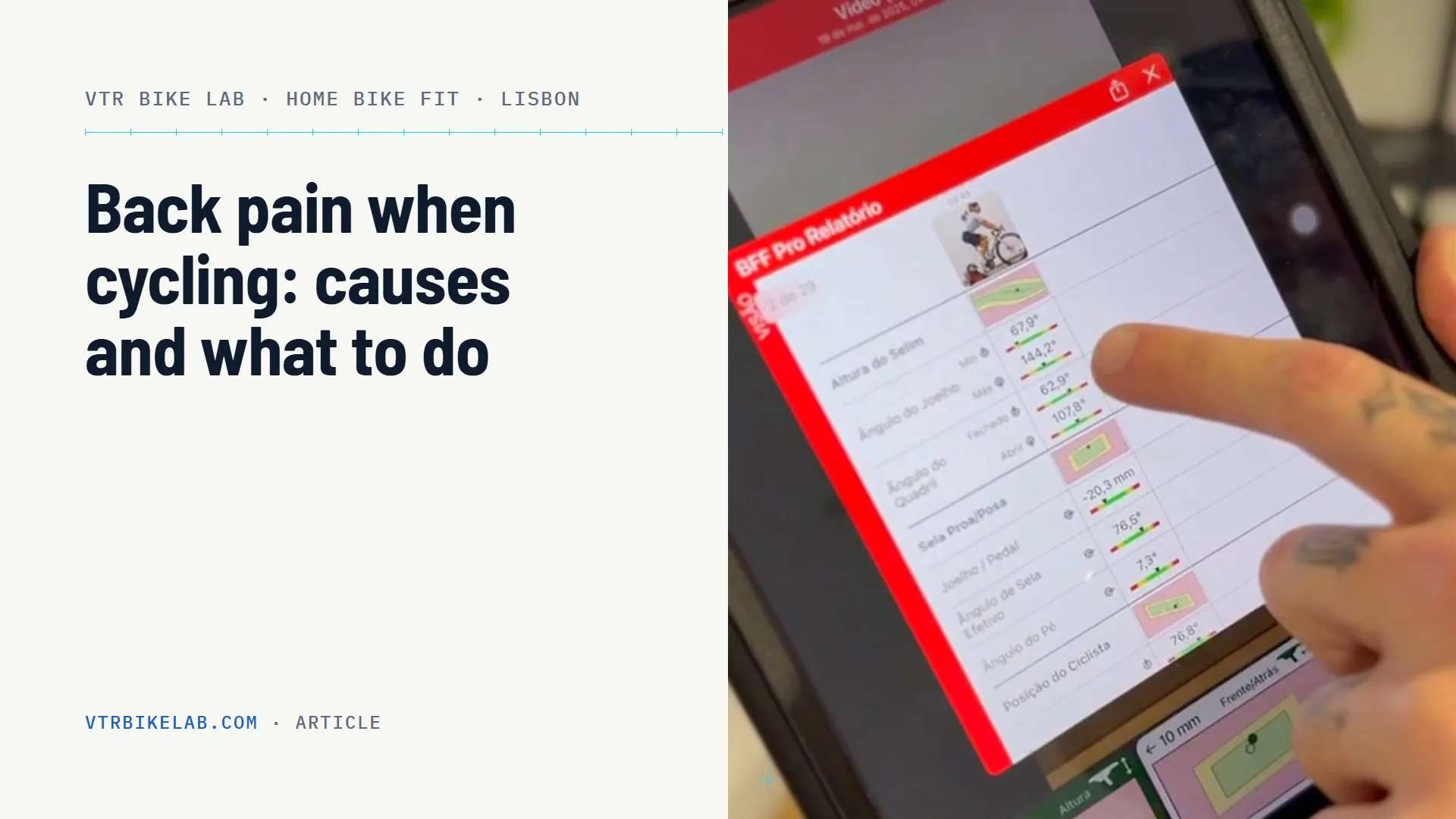
Short answer: Back pain after cycling is linked to trunk position and to the back muscles. A handlebar that is lower and further from the saddle was associated with more lumbar flexion (Antequera-Vique, 2023); cyclists with lower back pain had less endurance in the back extensors (Streisfeld, 2017). In the bike fit I measure the trunk and the hip while you pedal and adjust the handlebar height and reach. A bike fit does not diagnose or treat.
Back pain after cycling: what could it be?
What the research finds is a mix of position, muscles and time on the bike. In a survey of 518 recreational cyclists, 30.3% reported back complaints (Wilber, 1995).
| What was observed | In whom | Source |
|---|---|---|
| Lower handlebar, more lumbosacral flexion | review of 8 studies | Streisfeld, 2017 |
| Less endurance of the back extensor muscles | cyclists with lower back pain | Streisfeld, 2017 |
| More lower lumbar flexion and loss of multifidus co-contraction | pilot study, 9 cyclists with pain and 9 without pain | Burnett, 2004 |
| More thoracic flexion as the ride goes on | 12 studies in a review | Antequera-Vique, 2023 |
The multifidus muscles are small muscles next to the spine, known as stabilisers of the lower back (Burnett, 2004).
Lower back pain in cycling: is the handlebar too low?
It may be, but it is not only the height. The 2023 review brought together two findings:
- 15 studies observed more pelvic tilt with a lower handlebar (Antequera-Vique, 2023).
- 16 studies found more lumbar curvature with the hand position on the handlebar lower and further away from the saddle (Antequera-Vique, 2023).
That is why I look at height and at reach. Raising the handlebar without touching the stem, the part that holds it, may change little at the trunk.
Back pain when riding a bike: why does it only appear after an hour?
Because the position does not stay the same from start to finish. In the same review, 12 studies reported more thoracic flexion as pedalling time increases (Antequera-Vique, 2023).
| Point in the ride | What happens to the trunk |
|---|---|
| First minutes | you stay in the position you sat down in |
| Midway | your back gradually rounds, without you noticing |
| When the pain appears | your posture has already given way and the lower back works more bent |
That is why a photograph taken with you stationary, or in the first minutes, does not show the position in which it hurts.
Back pain and the bike: what to do off it?
Strength training. In a meta-analysis of 25 trials across several sports, strength training reduced sports injuries to less than a third, and exercise programmes, taken together, almost halved overuse injuries; stretching, on its own, had no effect (Lauersen, 2014).
- Endurance exercises for the back: bridge, side plank, on all fours with opposite arm and leg.
- Long, controlled sets, rather than a few heavy repetitions: the deficit found was one of endurance (Streisfeld, 2017).
- Besides position, load counts too: poorly dosed training on top of a poorly adjusted position is the perfect pair for pain and injury.
A concrete example
A road cyclist with lower back pain from the first hour onwards, never at the start. I filmed him fresh and again at the end of the session, already tired. In the second recording, the trunk rounded and the reach to the handlebar became long.
I raised the handlebar with a spacer and filmed him again. The reach was still long: he left with the measurement for a shorter stem to swap in. He also took away the advice to give it two weeks before changing anything else.
What to do today
- Note at what minute of the ride the pain starts.
- Change position on purpose: hands on top of the handlebar, on the brake levers (hoods) and down on the drops, and get out of the saddle on climbs.
- Start endurance exercises for the back, off the bike.
When this gets measured
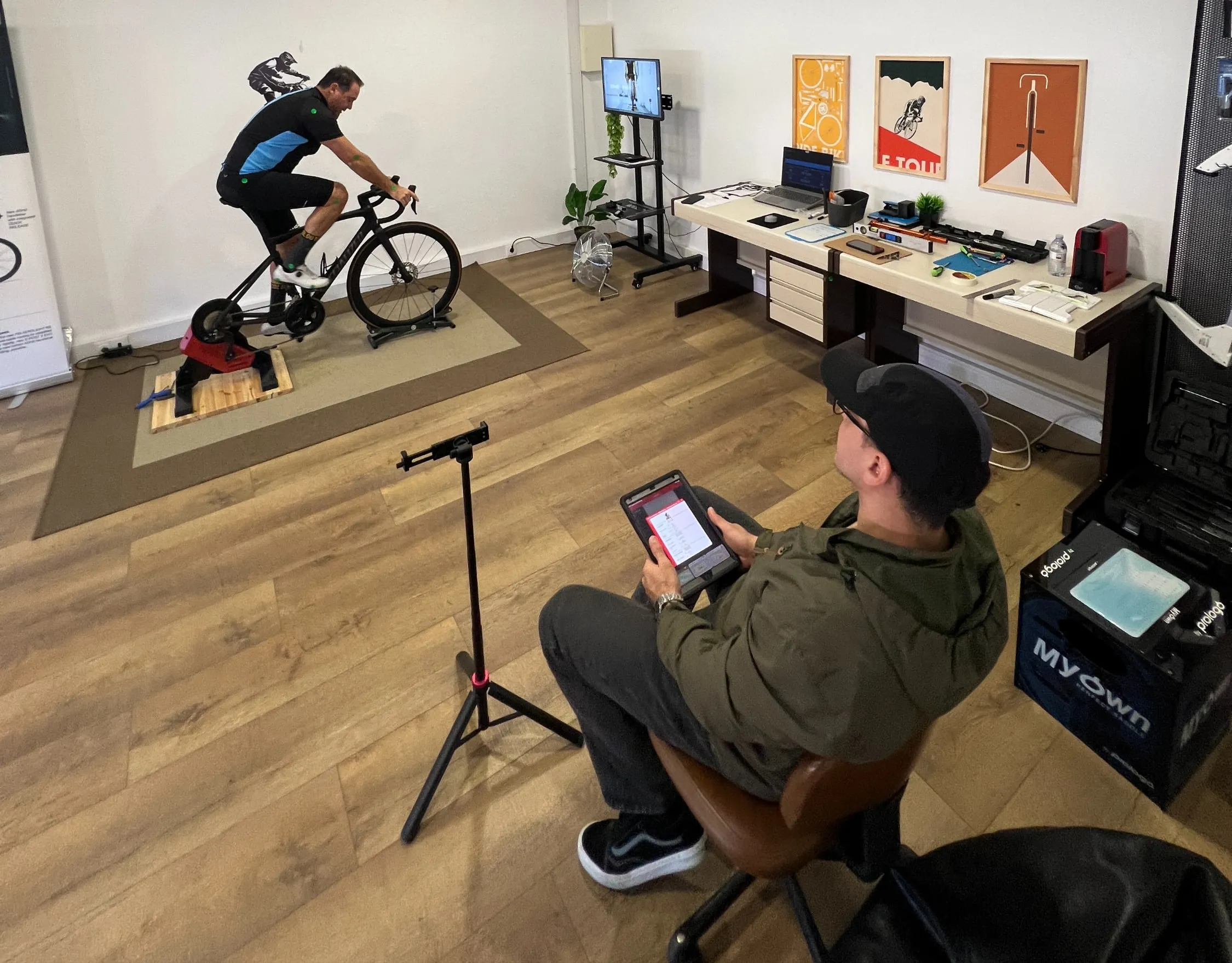
The lower and further away the handlebar, the more the lower back bends (Antequera-Vique, 2023). In the bike fit, at your home, I measure the inclination of the trunk and the hip while you pedal on the trainer, and the reach to the handlebar. I adjust the height and the reach in the session itself and film again.
Pain that radiates into the leg, loss of strength, a change in sensation, swelling or pain at rest: see a doctor, before any adjustment.
Frequently asked questions
Lower back pain in cycling: is it the handlebar? It may be part of the explanation: a handlebar that is lower and further away was associated with more lumbar flexion (Antequera-Vique, 2023). But the studies are cross-sectional and do not prove cause. Change one thing at a time and see whether the pain appears later.
Back pain when riding a bike: is it a lack of core? “Core” is vague. In cyclists with lower back pain, less endurance was found in the muscles that extend the back (Streisfeld, 2017) and less co-contraction of the multifidus muscles (Burnett, 2004). You train endurance, not just the abdominals.
Can I cycle with back pain? If the pain is mild and goes away after the ride, shorten your rides and change position more often. If it radiates into the leg, if there is loss of strength, tingling or pain at rest, see a doctor before you ride again.
Sources
- Streisfeld GM, Bartoszek C, Creran E, Inge B, McShane MD, Johnston T. Relationship between body positioning, muscle activity, and spinal kinematics in cyclists with and without low back pain: a systematic review. Sports Health. 2017;9(1):75-79. DOI 10.1177/1941738116676260 · PMID 27784817 — https://pubmed.ncbi.nlm.nih.gov/27784817/
- Antequera-Vique JA, Oliva-Lozano JM, Muyor JM. Effects of cycling on the morphology and spinal posture in professional and recreational cyclists: a systematic review. Sports Biomech. 2023;22(4):567-596. DOI 10.1080/14763141.2022.2058990 · PMID 35440291 — https://pubmed.ncbi.nlm.nih.gov/35440291/
- Burnett AF, Cornelius MW, Dankaerts W, O’Sullivan PB. Spinal kinematics and trunk muscle activity in cyclists: a comparison between healthy controls and non-specific chronic low back pain subjects — a pilot investigation. Man Ther. 2004;9(4):211-9. DOI 10.1016/j.math.2004.06.002 · PMID 15522646 — https://pubmed.ncbi.nlm.nih.gov/15522646/
- Wilber CA, Holland GJ, Madison RE, Loy SF. An epidemiological analysis of overuse injuries among recreational cyclists. Int J Sports Med. 1995;16(3):201-6. DOI 10.1055/s-2007-972992 · PMID 7649713 — https://pubmed.ncbi.nlm.nih.gov/7649713/
- Lauersen JB, Bertelsen DM, Andersen LB. The effectiveness of exercise interventions to prevent sports injuries: a systematic review and meta-analysis of randomised controlled trials. Br J Sports Med. 2014;48(11):871-7. DOI 10.1136/bjsports-2013-092538 · PMID 24100287 — https://pubmed.ncbi.nlm.nih.gov/24100287/