
Blog · · updated 23 November 2026
Road bike stem and handlebar: height and reach
Road bike stem and handlebar: how height and reach change the trunk, the back and the hands, and where to start adjusting. Lisbon, Portugal.
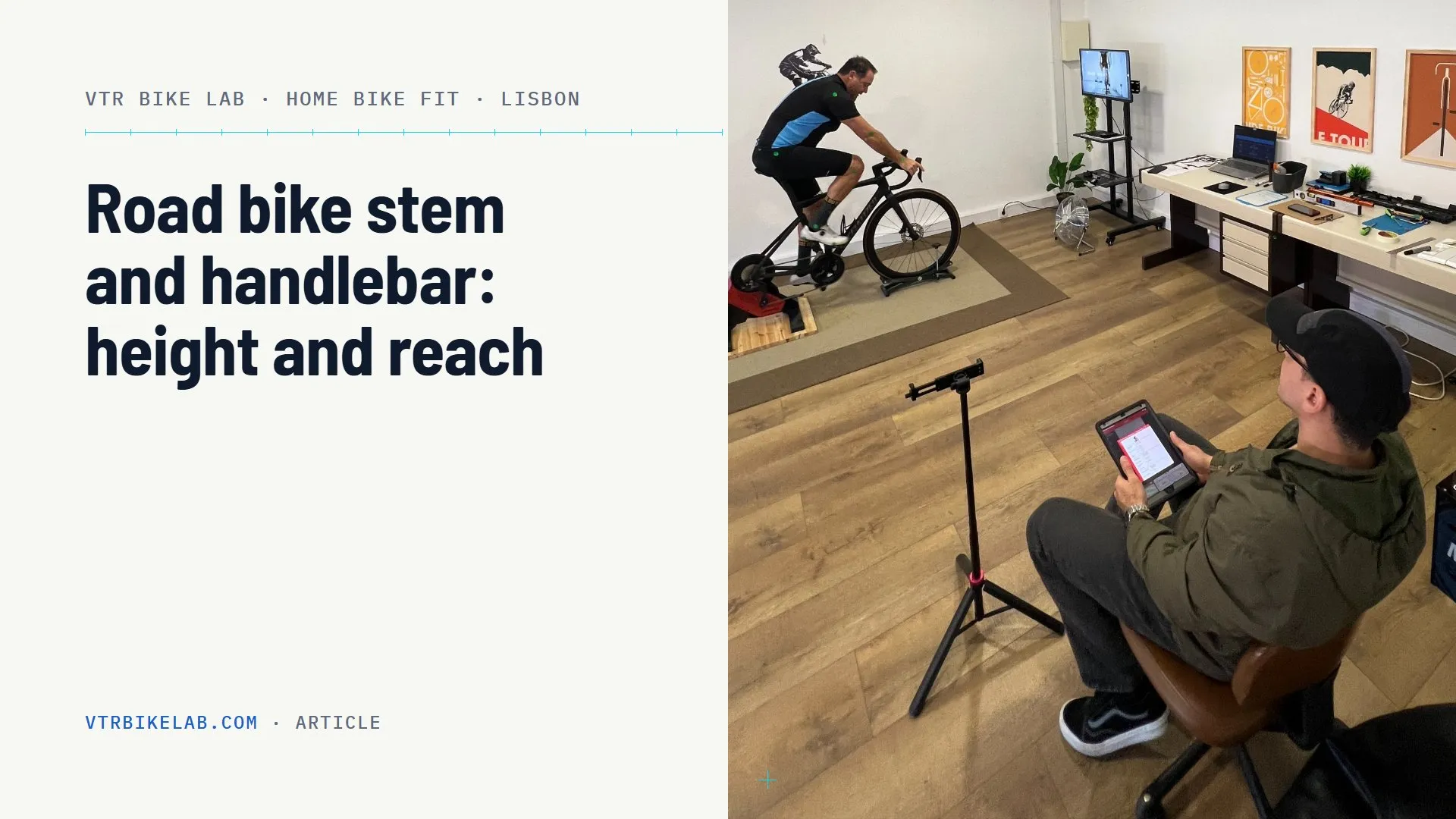
Short answer: The stem is the part that connects the handlebar to the bike: its length changes the reach; the spacers and the angle change the height. A lower handlebar, further away, was associated with more curvature in the lower back (Antequera-Vique, 2023) and, in trained cyclists, lowering the trunk reduced maximum power (Fintelman, 2015). It is adjusted after the saddle.
Road bike stem: what does it change?
Two things: the reach, how far away your hands are, and the handlebar height. It is adjusted after the saddle, because saddle height and setback already change the distance to the handlebar.
| Adjustment | Changes | Bear in mind |
|---|---|---|
| Stem length | the reach | the part is swapped |
| Stem angle (pointing up or down) | the handlebar height | pointing up, it also brings it closer |
| Spacers under the stem | the handlebar height | limited by the steerer tube |
| Adjustable stem | height and reach | good for testing before buying the final one |
Do not cut the steerer tube before you have the height tested: once cut, there is no going back.
Lower handlebar: what happens to the back?
The spine bends more. It is an association seen in several reviews, not a rule for everyone.
- More lumbosacral flexion with a lower handlebar, in a review of 8 studies (Streisfeld, 2017).
- Greater pelvic tilt with a lower handlebar, in 15 studies (Antequera-Vique, 2023).
- More lumbar curvature with a lower hand position, further away, in 16 studies (Antequera-Vique, 2023).
- A tendency towards more thoracic flexion as the time spent pedalling increases, in 12 studies (Antequera-Vique, 2023).
In cyclists with lower back pain, lower endurance of the back extensor muscles was also seen (Streisfeld, 2017). Handlebar position is the first thing to measure; besides that, this endurance can also be trained.
Going lower also has a cost in effort. In 19 well-trained cyclists, all men, in time trial positions, lowering the trunk reduced maximum power and increased oxygen consumption at the same effort (Fintelman, 2015).
Road bike handlebar: where to put your hands?
In several hand positions, and change hand position throughout the ride. In 36 experienced cyclists, hands low (in the drops) had the highest pressure at the base of the hand, on the little finger side, and the most extended wrist (Slane, 2011).
- Padded gloves reduced that pressure by 10 to 28%, a little more with thin foam (Slane, 2011).
- Pressure is not injury: the study measured pressure, not symptoms.
- Changing hand position spreads the weight over different areas of the hand.
Mountain bike handlebar: what changes?
The logic is the same: height and reach. The handlebar is straight, has a single hand position, and the position changes with the terrain. In the sources I use there are no data on mountain bike handlebar width; there, the test decides.
- Check the handlebar height with the saddle at pedalling height.
- Line the brake levers up with your forearm.
- Test the width on a trail you know before cutting the handlebar.
A concrete example
Think of a cyclist with a new road bike, original stem, who feels numb hands and the lower back after an hour and a half. First I check the saddle height and setback, because they change the reach.
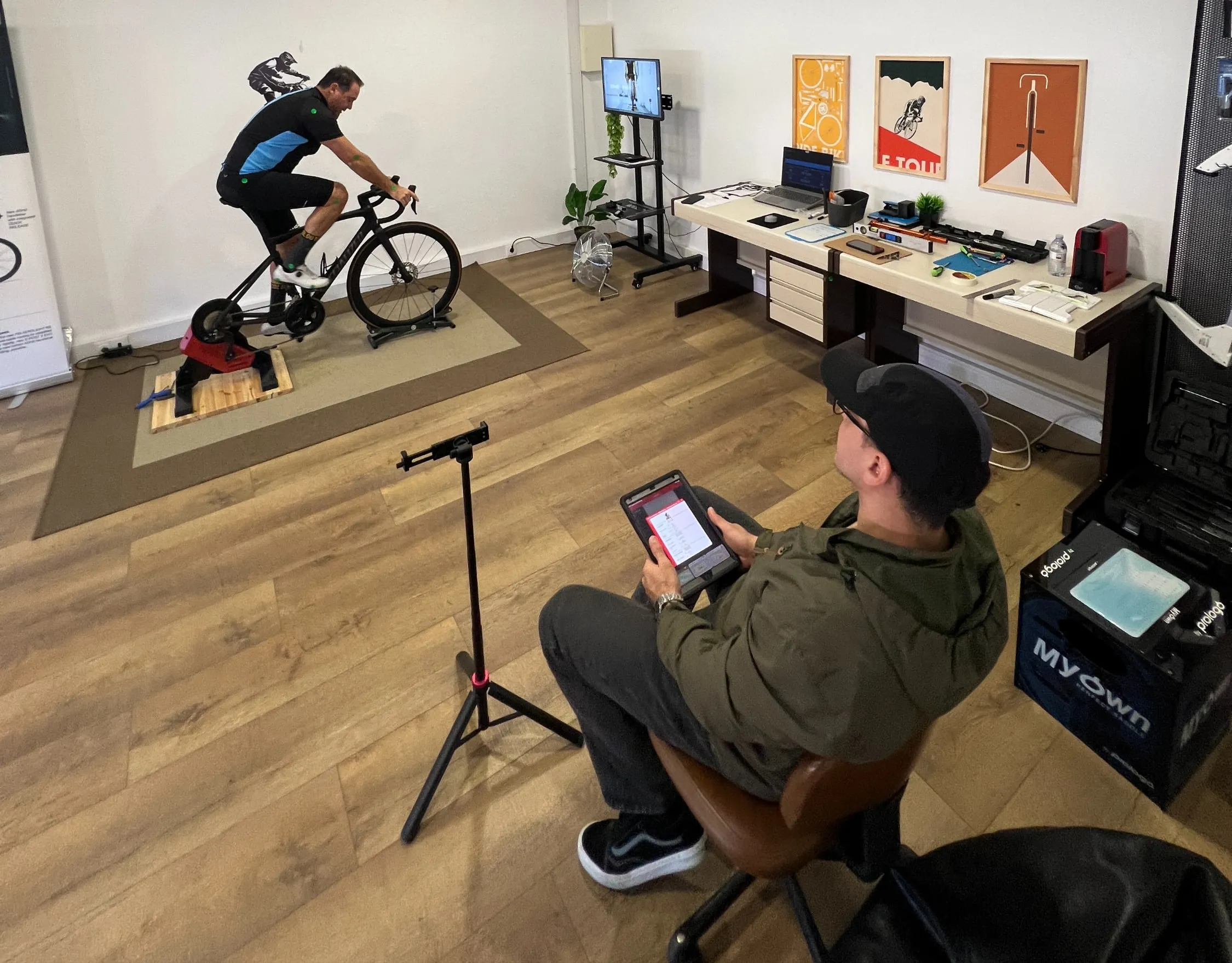
Then I film the trunk and the shoulder in the various hand positions. I raise the handlebar with a spacer or swap the stem, and film again at the same pace. I compare the angles before and after and write the final position in the report.
What to do today
- Change hand position every few minutes, especially on long rides.
- Test the height with spacers before cutting the steerer tube.
- Film yourself from the side with your hands on top and down in the drops, and compare the trunk.
When this gets measured
Weight on the hands, the back and the neck depend on the handlebar height and reach, and also on the saddle tilt and setback.
In the bike fit, at your home, I measure the trunk and the shoulder on video in the various hand positions and adjust the stem and the spacers during the session itself.
Tingling in the hands that does not go away, loss of strength or pain that runs down the arm are for the doctor, not for the Allen key.
Frequently asked questions
Road bike stem: what length to choose? The one that lets you reach the hand positions with your elbows slightly bent and your trunk at a lean you can sustain. There is no reliable chart: it is decided after setting the saddle, and an adjustable stem helps with testing.
Road bike handlebar: what height? The one you can hold for the whole ride without pain in the back, the neck or the hands. A lower handlebar was associated with more lumbar flexion (Streisfeld, 2017) and, in trained cyclists, lowering the trunk reduced maximum power (Fintelman, 2015).
Is an adjustable bike stem worth it? For testing, yes: you change the height and the reach without buying several parts. Once you have found the position, you can swap it for a fixed stem with the same measurements, which is lighter.
Sources
- Streisfeld GM, Bartoszek C, Creran E, Inge B, McShane MD, Johnston T. Relationship Between Body Positioning, Muscle Activity, and Spinal Kinematics in Cyclists With and Without Low Back Pain: A Systematic Review. Sports Health. 2017;9(1):75-79. DOI 10.1177/1941738116676260 · PMID 27784817 — https://pubmed.ncbi.nlm.nih.gov/27784817/
- Antequera-Vique JA, Oliva-Lozano JM, Muyor JM. Effects of cycling on the morphology and spinal posture in professional and recreational cyclists: a systematic review. Sports Biomech. 2023;22(4):567-596. DOI 10.1080/14763141.2022.2058990 · PMID 35440291 — https://pubmed.ncbi.nlm.nih.gov/35440291/
- Fintelman DM, Sterling M, Hemida H, Li FX. The effect of time trial cycling position on physiological and aerodynamic variables. J Sports Sci. 2015;33(16):1730-7. DOI 10.1080/02640414.2015.1009936 · PMID 25658151 — https://pubmed.ncbi.nlm.nih.gov/25658151/
- Slane J, Timmerman M, Ploeg HL, Thelen DG. The influence of glove and hand position on pressure over the ulnar nerve during cycling. Clin Biomech (Bristol). 2011;26(6):642-8. DOI 10.1016/j.clinbiomech.2011.03.003 · PMID 21458120 — https://pubmed.ncbi.nlm.nih.gov/21458120/