
Blog · · updated 23 November 2026
Stretching before cycling: does it help? How to warm up
Stretching before cycling: what studies show on performance and injuries, how to warm up on the bike and whether to stretch afterwards. Lisbon, Portugal.
Short answer: Before a ride, warming up on the bike is worth more than stretching standing still. In a systematic review, static stretching lowered performance immediately afterwards by 3.7% on average, and dynamic stretching raised it by 1.3% (Behm, 2016). And stretching, on its own, did not reduce injuries in the trials analysed (Lauersen, 2014). Start pedalling easy and raise the intensity gradually.
Should I stretch before a ride?
It isn’t necessary. If you like stretching, do a short time per muscle and ride straight afterwards. The effect on performance measured straight after:
| Type of stretching, before the effort | Effect on performance | Source |
|---|---|---|
| Static, less than 60 s per muscle | −1.1% | Behm, 2016 |
| Static, 60 s or more per muscle | −4.6% | Behm, 2016 |
| Static, average of all studies | −3.7% | Behm, 2016 |
| Dynamic, with movement | +1.3% | Behm, 2016 |
When studies added dynamic activity after the stretching, the negative effect was no longer clear. That is why the authors recommend stretching within a warm-up that continues with movement (Behm, 2016).
Does stretching reduce injuries in cycling?
In the trials analysed, no. A meta-analysis of 25 trials on sports injuries, not only in cyclists, found this (Lauersen, 2014):
- Stretching: relative risk of 0.963, in other words, no effect.
- Strength training: injuries reduced to less than a third in the trials.
- Gains in range of motion from stretching typically last less than 30 minutes (Behm, 2016).
If the aim is to protect the body, the time goes further in strength training than in stretching.
How to warm up for cycling?
With the RAMP model, adapted to the bike. RAMP stands for raise, activate, mobilise and potentiate.
| Phase | On the bike |
|---|---|
| Raise | pedal easy, in an easy gear, until your breathing rises |
| Activate and mobilise | vary the cadence, pedal standing for a few seconds, loosen shoulders and neck |
| Potentiate | a few short accelerations before the first hard effort |
In a study with 14 young footballers, RAMP gave better results in sprinting and jumping than static stretching and than not warming up (Girginer, 2025). It was football and not cycling, but the logic is the same: build up gradually.
Stretching after a ride: is it worth it?
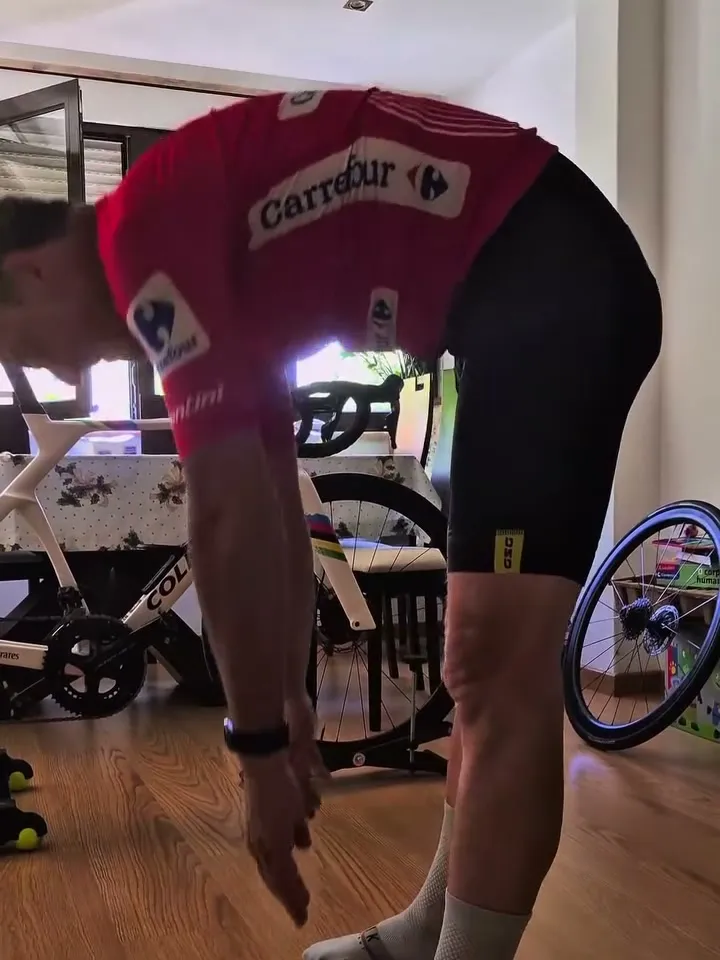
If it feels good, stretch. Just don’t count on it to protect your knees or your back: neither static stretching nor neuromuscular facilitation stretching showed a clear effect on injuries (Behm, 2016).
- To relax: go ahead.
- To gain range of motion: the effect of one session wears off quickly.
- For pains that always come back when riding: that gets measured in the position, as well as reviewing the training.
A concrete example
A cyclist who would arrive at the group’s meeting point, do long static stretches leaning against the car and set off straight into a climb. He complained of “blocked” legs in the first kilometres and of reaching the top of the first climb already out of breath.
We swapped the stretches for a warm-up on the bike: pedalling easy in an easy gear, then varying the cadence, and only then two or three short accelerations before the first climb. The stretching was left for home, if it felt good to him. He compared how it felt on the following rides, on the same climb.
What to do today
- Start your next ride pedalling easy before any climb.
- If you stretch beforehand, do less than 60 seconds per muscle and ride straight afterwards.
- Swap part of your stretching time for strength training during the week.
When to ask for help
- Physiotherapist: stiffness or pain that limits your movement off the bike.
- Doctor: joint pain that does not go away, swelling or pain that radiates.
- Position measurement: stiffness or pain that always comes back when riding gets measured, as well as reviewing the training. Poorly dosed training on top of a poorly adjusted position is the perfect pair for aches and injuries.
Frequently asked questions
Which stretches to do before a ride? Dynamic and short ones: leg swings, hip circles, loosening the shoulders. Dynamic stretching raised performance by 1.3% and static stretching lowered it by 3.7% on average (Behm, 2016). Better still is to start pedalling easy and build up gradually.
Does stretching after a ride help recovery? The sources I use did not measure recovery. On injuries, stretching showed no effect (Lauersen, 2014). If it feels good and helps you relax, stretch; it does not replace rest, food or strength training.
How long should the warm-up be before a ride? There is no single number in the sources I use. Warm up until your breathing and your legs are ready for the effort that comes next. The harder the start of the ride, the more thorough the warm-up should be.
Sources
- Behm DG, Blazevich AJ, Kay AD, McHugh M. Acute effects of muscle stretching on physical performance, range of motion, and injury incidence in healthy active individuals: a systematic review. Appl Physiol Nutr Metab. 2016;41(1):1-11. DOI 10.1139/apnm-2015-0235 · PMID 26642915 — https://pubmed.ncbi.nlm.nih.gov/26642915/
- Lauersen JB, Bertelsen DM, Andersen LB. The effectiveness of exercise interventions to prevent sports injuries: a systematic review and meta-analysis of randomised controlled trials. Br J Sports Med. 2014;48(11):871-7. DOI 10.1136/bjsports-2013-092538 · PMID 24100287 — https://pubmed.ncbi.nlm.nih.gov/24100287/
- Girginer FG, Seyhan S, Açar G, Bilici MF, Bilici ÖF, Soylu Ç. Acute effects of the RAMP warm-up on sprint and jump performance in youth soccer players. Front Physiol. 2025;16:1612611. DOI 10.3389/fphys.2025.1612611 · PMID 40630396 · PMC12234454 — https://pubmed.ncbi.nlm.nih.gov/40630396/