
Blog · · updated 23 November 2026
Saddle numbness: why it happens, in men and in women
Saddle numbness? The nerve is the pudendal. What studies say about pressure, cut-outs, width and standing up, in men and women. Lisbon, Portugal.
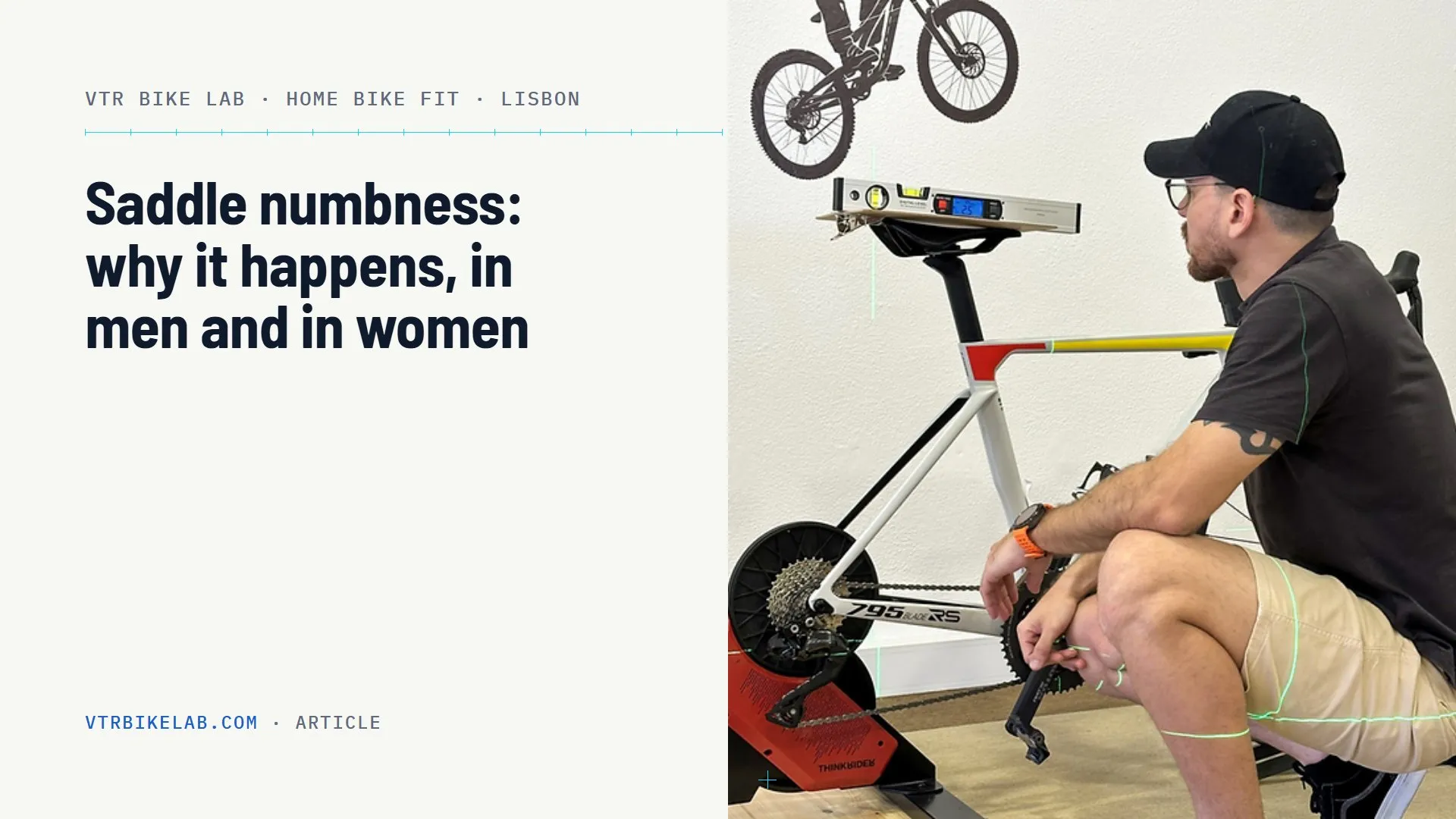
Short answer: When the saddle makes you go numb, the compressed nerve is the pudendal, which runs through the perineum. The pressure depends on position: saddle height, tilt and setback change how much weight falls at the front. In 46 men, oxygenation at the glans fell from 60.5 to 17.9 mmHg on sitting on the saddle (Sommer, 2001); in women, the cut-out gave more pressure, not less (Guess, 2011). In the bike fit I level and measure the saddle and film the hip while you pedal.
Why does the saddle make you go numb?
Because the weight rests on an area that nerves and blood vessels pass through. The nerve is the pudendal; compression takes away sensation and reduces local oxygenation.
- One review indicates that genital numbness is reported by 50 to 91% of cyclists, depending on the study (Leibovitch & Mor, 2005).
- In 46 healthy men, oxygenation at the glans went from 60.5 mmHg standing to 17.9 mmHg seated on the saddle (Sommer, 2001).
- In the reclining position, in the same study, oxygenation stayed the same as at rest (Sommer, 2001).
Bike saddle for women: what do the studies say?
There is less research in women, and what exists contradicts part of the common wisdom.
| Study | What it found |
|---|---|
| 114 club cyclists, after 2 hours or more (Hermans, 2016) | 34.9% with genital numbness and 40.0% with vulvar discomfort |
| 48 competitive cyclists (Guess, 2011) | cut-out saddle: +4 kPa mean pressure and +11 kPa peak pressure on the perineum |
| The same 48 cyclists (Guess, 2011) | wider saddles were associated with lower peak pressure |
These are cross-sectional studies: they show association, not cause. In the survey, the questionnaires were not validated and the response rate was low (Hermans, 2016).
Cut-out or noseless saddle: does it help?
It depends on who is riding and how they ride. The data for men and for women do not point in the same direction.
- Men: in a review of 22 studies, the noseless saddle reduced pressure on the perineum, at the cost of less stability and more pressure at the back (Litwinowicz, 2021).
- Women: the cut-out was associated with more pressure on the perineum, not less (Guess, 2011).
- Width: in the female club cyclists, the wider saddle was associated with more urinary complaints (Hermans, 2016).
In other words, neither the cut-out nor the width is a rule. Test before you buy.
Perineal pressure in cycling: what reduces it?
The measures with the most support are simple, and the first two cost nothing.
| Measure | What was measured |
|---|---|
| Standing up out of the saddle | about every 10 minutes “may be effective”, with indirect evidence (Litwinowicz, 2021) |
| Standing up after riding | oxygenation back to normal after 10 minutes (Sommer, 2001) |
| Seatpost with a shock absorber | reduced the effect of oscillation on perineal pressure by 53%, in the laboratory and without pedalling (Sanford, 2018) |
On top of that, I always check the saddle height and tilt: a high saddle makes the hip rock, and a nose tilted up loads the front.
A concrete example
A cyclist with numbness in the perineum from 45 minutes onwards, even with a new cut-out saddle. On video, the hip rocked from side to side and the saddle nose was tilted up.
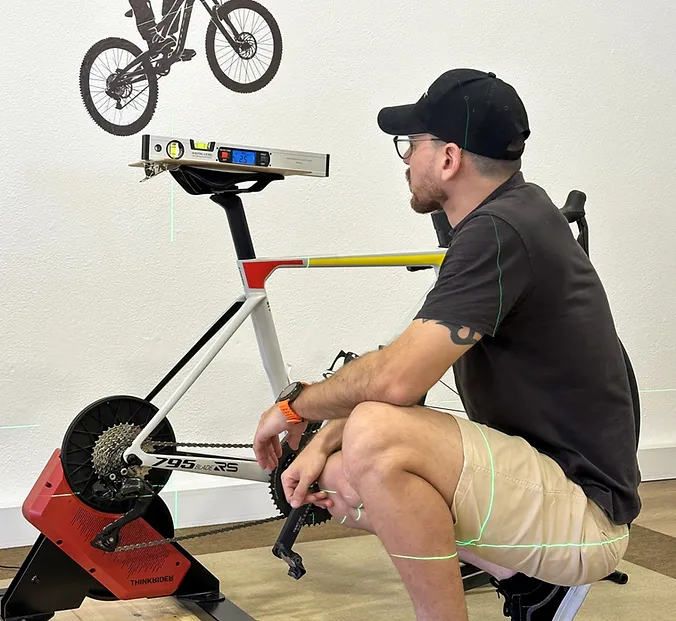
I levelled the saddle with the digital level, lowered it until the hip stopped rocking and filmed again. The rider left with the advice to stand up out of the saddle every 10 minutes on the first rides (Litwinowicz, 2021) and to tell me whether the numbness changed.
What to do today
- Stand up out of the saddle for a few seconds at regular intervals, before you feel the numbness.
- Check with a spirit level, or with the app on your phone, whether the saddle is level.
- Before changing saddle, test the height and the tilt of the one you have.
When this gets measured
Saddle height, tilt and setback change how much weight falls on the perineum. In the bike fit, at your home, I level the saddle, measure the height and the setback and check on video whether the hip rocks or slides forward. I adjust in the session itself and film again.
If you want to try before you buy, there is the Saddle test + basic adjustment, for €127. You test several different saddle platforms, and the saddle height and fore/aft are adjusted with software and markers capturing the angles. The saddle you choose is paid for separately. With the Bike Fit Performance, the two together cost €189.
A bike fit does not diagnose or treat: with numbness that lasts for hours after the ride, urinary or sexual changes, or pain in the perineum, see a doctor (urology or gynaecology).
Frequently asked questions
Why does the saddle make you go numb? Because the weight compresses the pudendal nerve and the blood vessels of the perineum. In 46 men, oxygenation at the glans fell from 60.5 to 17.9 mmHg on sitting on the saddle (Sommer, 2001). Standing up regularly relieves the compression.
Is a cut-out saddle better for women? Not necessarily. In 48 competitive cyclists, the women who used a cut-out saddle had more pressure on the perineum, not less (Guess, 2011). It is a cross-sectional study: test before you buy.
Genital numbness in cycling: when to see a doctor? When it lasts for hours or days after the ride, always comes back, or comes with pain, urinary or sexual changes. A bike fit does not diagnose or treat: it adjusts the bike, and the doctor assesses the rest.
Sources
- Sommer F, Schwarzer U, Klotz T, Caspers HP, Haupt G, Engelmann U. Erectile dysfunction in cyclists. Is there any difference in penile blood flow during cycling in an upright versus a reclining position? Eur Urol. 2001;39(6):720-3. DOI 10.1159/000052533 · PMID 11464064 — https://pubmed.ncbi.nlm.nih.gov/11464064/
- Leibovitch I, Mor Y. The vicious cycling: bicycling related urogenital disorders. Eur Urol. 2005;47(3):277-86. DOI 10.1016/j.eururo.2004.10.024 · PMID 15716187 — https://pubmed.ncbi.nlm.nih.gov/15716187/
- Hermans TJ, Wijn RP, Winkens B, Van Kerrebroeck PE. Urogenital and sexual complaints in female club cyclists — a cross-sectional study. J Sex Med. 2016;13(1):40-5. DOI 10.1016/j.jsxm.2015.11.004 · PMID 26755085 — https://pubmed.ncbi.nlm.nih.gov/26755085/
- Guess MK, Partin SN, Schrader S, Lowe B, LaCombe J, Reutman S, et al. Women’s bike seats: a pressing matter for competitive female cyclists. J Sex Med. 2011;8(11):3144-53. DOI 10.1111/j.1743-6109.2011.02437.x · PMID 21834869 — https://pubmed.ncbi.nlm.nih.gov/21834869/
- Litwinowicz K, Choroszy M, Wróbel A. Strategies for reducing the impact of cycling on the perineum in healthy males: systematic review and meta-analysis. Sports Med. 2021;51(2):275-287. DOI 10.1007/s40279-020-01363-z · PMID 33074460 — https://pubmed.ncbi.nlm.nih.gov/33074460/
- Sanford T, Gadzinski AJ, Gaither T, Osterberg EC, Murphy GP, Carroll PR, et al. Effect of oscillation on perineal pressure in cyclists: implications for micro-trauma. Sex Med. 2018;6(3):239-247. DOI 10.1016/j.esxm.2018.05.002 · PMID 29936216 — https://pubmed.ncbi.nlm.nih.gov/29936216/