
Blog · · updated 23 November 2026
Numb hands when cycling: the nerve, the bar, what to change
Numb hands on the bike? Which nerve it is (ulnar or median), why position decides the weight on your hands and what gets adjusted in a bike fit, in Lisbon.
Short answer: Numb hands on the bike come from pressure on two nerves: the ulnar, if the little finger and the ring finger tingle; the median, if it is the thumb, the index finger and the middle finger. How much weight falls on the hands depends on position: saddle tilt and setback, handlebar height and reach, position of the brake levers (hoods). That is what I measure and adjust in the bike fit, and then I film again. Padded gloves and changing hand position help (Slane, 2011), but they are a complement.
Numb hands on the bike: which nerve is it?
Where the tingling is tells you which nerve is being squeezed.
| Where it tingles | Nerve | Where it is usually compressed |
|---|---|---|
| Little finger and half of the ring finger | ulnar | base of the palm, on the little-finger side |
| Thumb, index finger and middle finger | median | centre of the wrist |
In a survey of 518 recreational cyclists, 31.1% reported hand complaints (Wilber, 1995). It is a common complaint, but it is not one to ignore.
Tingling in the hands on the bike: what do the studies say?
The most cited studies come from extreme events, and that matters when reading them.
- 25 cyclists, 600 km event: 23 finished with motor symptoms, sensory symptoms or both; the sensory ones, mainly in the area of the ulnar nerve (Patterson, 2003).
- 14 cyclists, six days and 420 miles (about 675 km): the deep branch of the ulnar nerve began to conduct more slowly; the median, overall, did not change (Akuthota, 2005).
A 600 km event is not a 2-hour ride: these numbers show the mechanism, not how many people feel the same. The authors point to three measures: gloves, a correctly adjusted bike and changing hand position often (Patterson, 2003).
Cycling gloves and numbness: do they help?
They help, as a complement, but the thickest glove is not the best. In 36 experienced cyclists, in a laboratory study:
| Situation | Pressure at the base of the palm |
|---|---|
| No gloves | mean peaks of 134 to 165 kPa (Slane, 2011) |
| Low grip on the handlebar (the drops) | the highest pressure and the wrist bent furthest back (Slane, 2011) |
| Padded gloves | 10 to 28% less pressure; thin foam slightly better (Slane, 2011) |
Pressure is not injury: the study measured force on the hand, not symptoms. Thick padding can lift the hand and bend the wrist more. And a glove does not take away the weight that the position puts on the hands.
Road bike handlebar: what does position change for the hands?
Almost everything. The weight that falls on the hands depends on how you are sitting and on where the handlebar is. This is what I check first:
- Saddle: a nose tilted down, or a saddle too far forward, slides you towards the handlebar and loads the hands.
- Handlebar height and reach: low and far away puts the trunk forward and the weight on the hands.
- Tilt of the brake levers (hoods): the wrist should stay straight, in line with the forearm.
- Variation: switching between the top of the bar, the hoods and the drops throughout the ride.
If the weight is all at the front, the problem may not be in the hand but in the distribution between the saddle and the handlebar. And that can be measured and adjusted.
A concrete example
A road cyclist with tingling in the little finger and the ring finger of both hands from the first hour onwards. On video, the wrists bent back on top of the hoods, the trunk was a long way forward and the saddle had its nose tilted down.
I levelled the saddle, rotated the handlebar slightly upwards and raised it by one spacer. I filmed again: the wrist was in line with the forearm and the trunk moved back. The rider left with the advice to change hand position often and to tell me if the tingling had not changed in two weeks.
What to do today
- Check with a spirit level whether the saddle is level: with the nose down, the weight slides onto the hands.
- Change hand position on the handlebar several times per ride and keep the wrist in line with the forearm.
- Try gloves with thin padding, as a complement, not as a solution.
When this gets measured
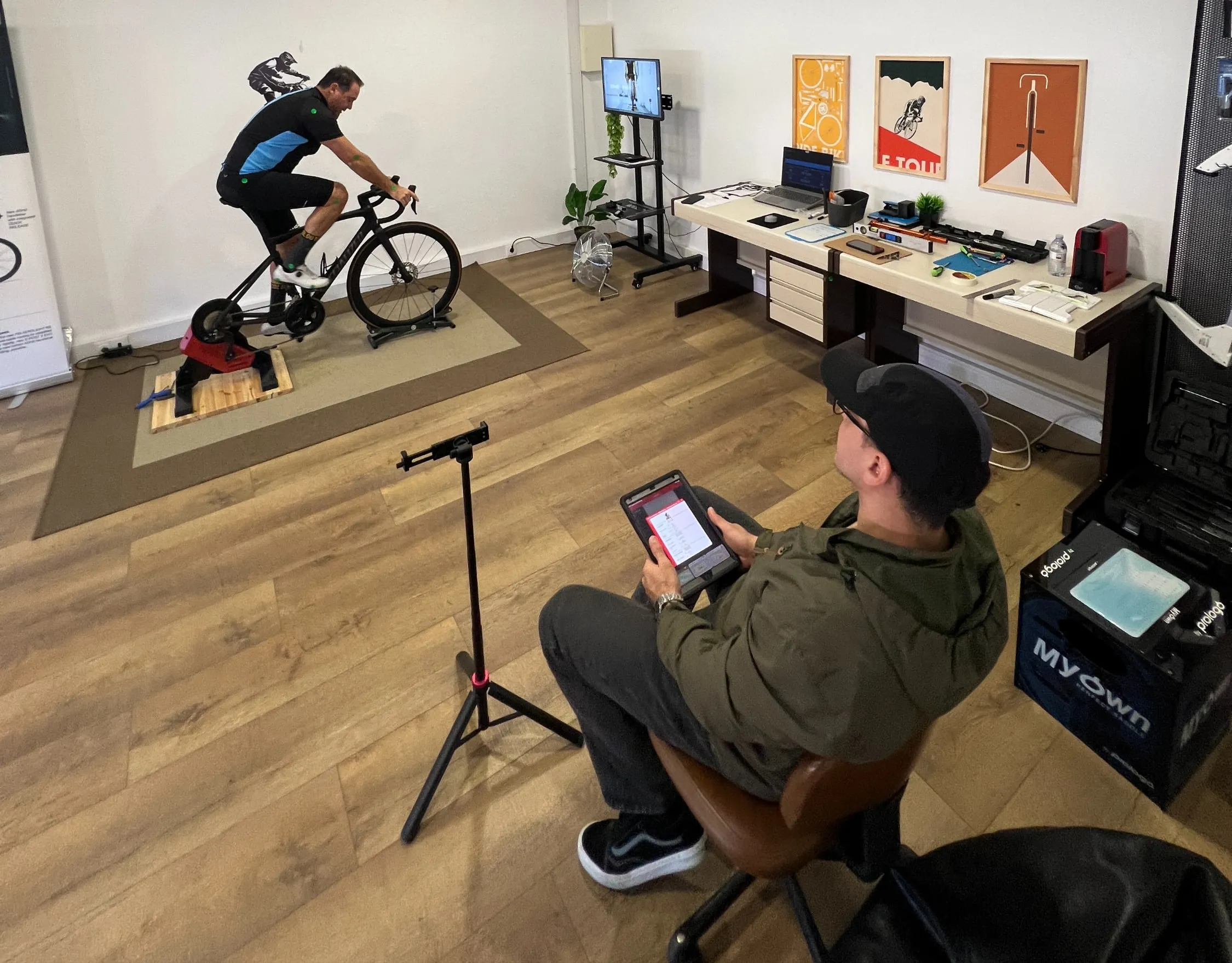
The weight that falls on the hands depends on position, and position can be measured. In the bike fit, at your home, I check the saddle tilt and setback, measure the trunk and shoulder angle while you pedal on the turbo trainer and look at how the wrist rests on the hoods.
I adjust the saddle, the handlebar height and reach and the tilt of the hoods in the session itself, and film again.
A bike fit does not diagnose or treat: with numbness that persists off the bike, loss of strength in the hand, worsening at night or pain that travels up the arm, see a doctor.
Frequently asked questions
Numb hands on the bike: is it normal? It is a common complaint: 31.1% of 518 recreational cyclists reported hand complaints (Wilber, 1995). Tingling that passes in minutes is different from tingling that lasts for hours or takes strength from the hand: with that kind, see a doctor.
Do cycling gloves help with numbness? In the laboratory, padded gloves reduced pressure on the hand by between 10 and 28%, with a slightly better result for thin foam (Slane, 2011). They are a complement: the weight that falls on the hands is taken off through position, with the saddle and the handlebar.
Tingling in the hands on the bike: when to see a doctor? When it lasts for hours after you get off the bike, gets worse at night, takes strength from the hand (you drop things, it is hard to open your fingers) or comes with pain along the arm. A bike fit does not diagnose or treat.
Sources
- Patterson JM, Jaggars MM, Boyer MI. Ulnar and median nerve palsy in long-distance cyclists. A prospective study. Am J Sports Med. 2003;31(4):585-9. DOI 10.1177/03635465030310041801 · PMID 12860549 — https://pubmed.ncbi.nlm.nih.gov/12860549/
- Akuthota V, Plastaras C, Lindberg K, Tobey J, Press J, Garvan C. The effect of long-distance bicycling on ulnar and median nerves: an electrophysiologic evaluation of cyclist palsy. Am J Sports Med. 2005;33(8):1224-30. DOI 10.1177/0363546505275131 · PMID 16000656 — https://pubmed.ncbi.nlm.nih.gov/16000656/
- Slane J, Timmerman M, Ploeg HL, Thelen DG. The influence of glove and hand position on pressure over the ulnar nerve during cycling. Clin Biomech (Bristol). 2011;26(6):642-8. DOI 10.1016/j.clinbiomech.2011.03.003 · PMID 21458120 — https://pubmed.ncbi.nlm.nih.gov/21458120/
- Wilber CA, Holland GJ, Madison RE, Loy SF. An epidemiological analysis of overuse injuries among recreational cyclists. Int J Sports Med. 1995;16(3):201-6. DOI 10.1055/s-2007-972992 · PMID 7649713 — https://pubmed.ncbi.nlm.nih.gov/7649713/