
Blog · · updated 23 November 2026
Saddle setback: how to measure, adjust and what it won't do
Saddle setback: what it is, how to measure with a plumb line or laser, how to adjust after height and what the knee-over-pedal rule can't support. Lisbon.
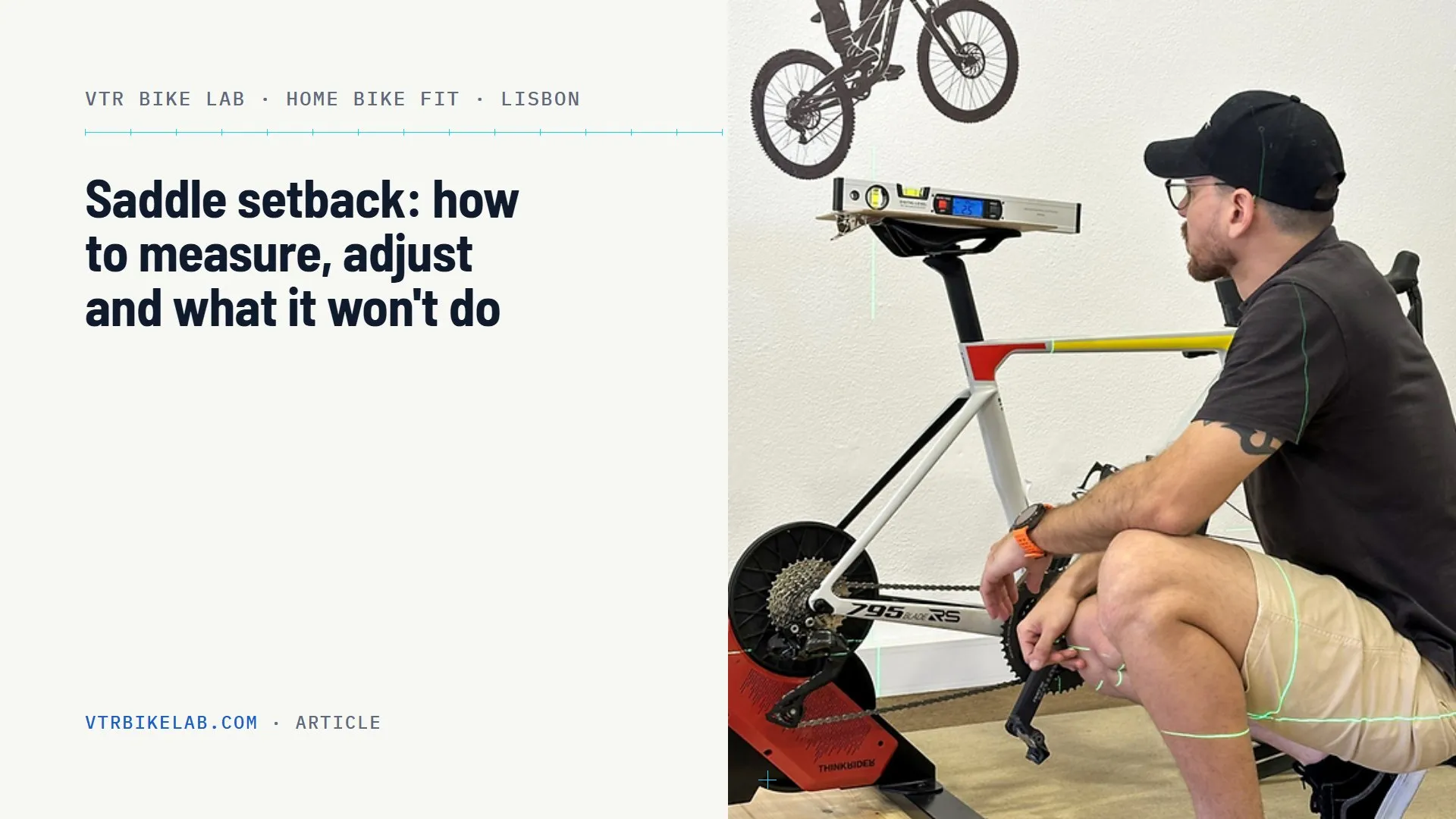
Short answer: Saddle setback is the horizontal distance between the bottom bracket axle and the tip of the saddle. It is measured with a plumb line or a laser line. Beyond saddle height there is no consensus on the ideal position (Husband, 2024), so setback is adjusted after height, a few millimetres at a time, and confirmed on video.
Saddle setback: what is it?
It is how far the saddle sits behind the bottom bracket axle. Saddle fore and aft are the same adjustment, in both directions, made on the saddle rails.
A note on the name: moving the saddle forward or back has nothing to do with the stem, the part that holds the handlebar. Here I am talking only about the saddle.
What changes when you move the setback:
- The hip angle and the trunk angle (Husband, 2024).
- The distance to the handlebar: moving the saddle back takes you further from it.
- The effective saddle height, which also changes a little.
How do you measure saddle setback?
- Bike level, on flat ground or on the turbo trainer.
- Plumb line or vertical laser line passing through the centre of the bottom bracket axle.
- Measure horizontally, from the line to the tip of the saddle.
- Note the point where you measured and, next to it, the saddle height.
If you change saddles, measure the same point on both. Short-nosed saddles mislead anyone who always measures to the tip.
Does the knee-over-pedal rule work?
KOPS (knee over the pedal spindle, with the crank horizontal) is a workshop convention. A 2024 systematic review found no consensus for any position variable other than saddle height (Husband, 2024).
| Common idea | What the studies show |
|---|---|
| “Knee over the pedal is the right position” | workshop convention; the review found no consensus beyond saddle height (Husband, 2024) |
| “Saddle forward damages the kneecap” | in a model with 10 cyclists, moving the saddle forward did not increase the force on the kneecap (Menard, 2020) |
| “Moving the saddle back protects the knee” | in the same model, moving it back increased the compression inside the knee (Menard, 2020) |
| “There is one right value for everyone” | of the 47 studies analysed, none was rated as good quality (Husband, 2024) |
It is a laboratory model with 10 cyclists and a review of poor-quality studies: they serve to undo ready-made rules, not to create others.
How do you adjust saddle setback?
In the right order, because one adjustment affects the other:
- First the saddle height.
- Then the setback, a few millimetres at a time.
- Check the height again, as it changed with the setback.
- Only at the end, the stem and the handlebar.
Signs that make me look at the setback: sliding towards the tip of the saddle, a lot of weight on the hands, or the feeling of pushing the pedals out in front of you.
Moving the setback changes the effective height, and height counts: in most of the studies reviewed, changing the height by 5% altered knee kinematics by 35% (Bini, 2011).
Correct saddle position: what does setback not do?
- It does not replace the right height.
- It does not correct a frame of the wrong length.
- It does not replace the doctor: a bike fit measures and adjusts, it does not diagnose or treat.
A concrete example
Think of a cyclist who moved the saddle back to the end of the rails after reading that the knee behind the pedal protects the kneecap. Now the handlebar feels far away and the neck gets tense after an hour.
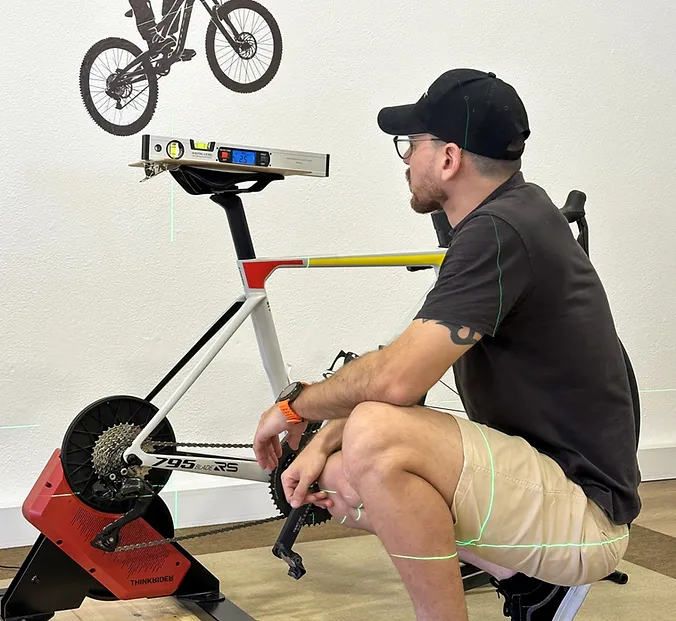
I measure height and setback with the laser line and film. I bring the saddle a few millimetres forward, measure the height again, which had risen with the setback, and film again. Only then do I look at the stem and the handlebar.
What to do today
- Measure your current setback with a plumb line and note it down together with the height.
- If you move it, change a few millimetres and measure the height again.
- Leave the stem and the handlebar until after the saddle.
When this gets measured
Sliding towards the tip of the saddle or loading the hands are signs that lead me to the setback. In the bike fit, at your home, I measure height and setback with a laser line, film the hip and the trunk while you pedal on the trainer and adjust during the session itself.
If the knee pain persists, swells or comes with loss of strength, the first step is to see a doctor.
Frequently asked questions
How do you measure saddle setback? With the bike level, run a plumb line or a laser line through the centre of the bottom bracket axle and measure horizontally to the tip of the saddle. Note the saddle height at the same time.
How do you adjust saddle setback? After the height, a few millimetres at a time, on the saddle rails. Measure the height again, as it changes with the setback, and only then move the stem and the handlebar.
Saddle fore and aft: what changes at the knee? In a model with 10 cyclists, moving the saddle forward did not increase the force on the kneecap, and moving it back increased the compression inside the knee (Menard, 2020). It is a small laboratory study: it is not a rule for everyone.
Sources
- Husband SP, Wainwright B, Wilson F, Crump D, Mockler D, Carragher P, Nugent F, Simms CK. Cycling position optimisation - a systematic review of the impact of positional changes on biomechanical and physiological factors in cycling. J Sports Sci. 2024;42(15):1477-1490. DOI 10.1080/02640414.2024.2394752 · PMID 39285616 — https://pubmed.ncbi.nlm.nih.gov/39285616/
- Menard M, Domalain M, Decatoire A, Lacouture P. Influence of saddle setback on knee joint forces in cycling. Sports Biomech. 2020;19(2):245-257 (epub 2018). DOI 10.1080/14763141.2018.1466906 · PMID 29920153 — https://pubmed.ncbi.nlm.nih.gov/29920153/
- Bini R, Hume PA, Croft JL. Effects of bicycle saddle height on knee injury risk and cycling performance. Sports Med. 2011;41(6):463-76. DOI 10.2165/11588740-000000000-00000 · PMID 21615188 — https://pubmed.ncbi.nlm.nih.gov/21615188/