
Blog · · updated 23 November 2026
Cycling biomechanical analysis: the 5 angles measured
Cycling biomechanics: the 5 angles measured on video (knee, hip, trunk, shoulder, foot), at rest vs pedalling, and what is still unknown. Lisbon, Portugal.
Short answer: A biomechanical analysis in cycling, which in Portugal is almost always called a bike fit, measures five angles on video while you pedal: knee, hip, trunk, shoulder and foot. The knee is the most studied: 25–35° of flexion measured at rest (Holmes, 1994) and 30–40° on video (Ferrer-Roca, 2012). For the hip and the shoulder, reference values are lacking (Swart & Holliday, 2019).
What is a cycling biomechanical analysis?
It is filming you pedalling and measuring the joint angles at fixed points of the pedal stroke. In Portugal people search more for “bike fit”; the work is the same.
What it takes:
- A turbo trainer, so you pedal in the same place at a controlled pace.
- A camera to the side, at bottom bracket height.
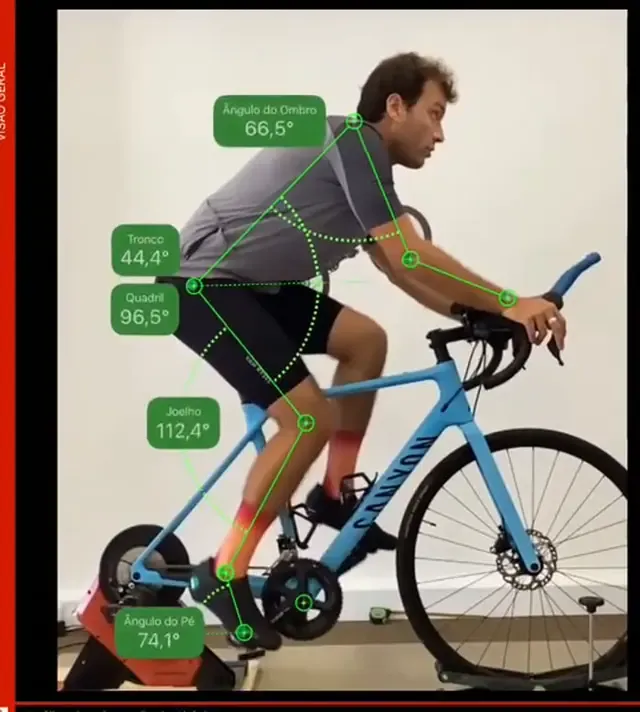
- Software that draws the skeleton over the video and measures the angles.
- Someone who knows what to do with the numbers.
Which five angles are measured and what do they say?
| Angle | Where it is read | What it tells me |
|---|---|---|
| Knee | pedal at the lowest point | whether the saddle is high, low or in the window |
| Foot (ankle) | pedal at the lowest point | whether the foot compensates for a high saddle |
| Hip | most closed point of the pedal stroke | how much the trunk closes over the thigh |
| Trunk | lean relative to the horizontal | how much the handlebar forces you to go low |
| Shoulder | between the arm and the trunk | whether the handlebar is far or near |
Only the knee has a well-studied reference window. Hip, shoulder and elbow have been little researched (Swart & Holliday, 2019); there I compare the video before and after each adjustment.
Knee angle in cycling: at rest or on video?
It depends on the method, and whoever gives you a number has to say which one they used.
- At rest, with a goniometer: 25–35° of flexion with the pedal at the bottom (Holmes, 1994).
- On video, pedalling: 30–40° (Ferrer-Roca, 2012).
- On video, by intensity: 33–43° at a low pace, 30–40° at a high pace (Swart & Holliday, 2019).
Why it changes: from static to pedalling, the foot points further down and knee flexion increases; the variation seems greater in novice cyclists (Peveler, 2012). That is why I film, and don’t measure only at rest.
Correct position on a road bike: what does the trunk say?
There is no published “correct” trunk angle for amateurs. There is a known cost to going too low.
In 19 well-trained cyclists, all men, in time trial positions, lowering the trunk reduced maximum power and increased oxygen consumption and ventilation at the same effort (Fintelman, 2015). Lower is more aerodynamic, but it has a cost.
What I look at in the trunk and the shoulder:
- A lean you can hold for the whole ride.
- Relaxed shoulders and slightly bent elbows.
- A neck that doesn’t strain to see the road.
Cycling biomechanics: what is still unknown?
More than sales websites suggest. The review by Swart and Holliday (2019) sums up the gaps:
- Video reference values are lacking for all joints other than the knee.
- Intensity changes the angles, so it is best to measure at an effort similar to that of your rides.
- Training load and flexibility have yet to be studied in the choice of position.
A concrete example
Think of a road cyclist who lowered his handlebar to be more aerodynamic and feels his neck after an hour. I film him from the side and measure trunk and shoulder, with his hands on top of the handlebar and in the drops.
Then I raise the handlebar with a spacer, film at the same pace and compare the two videos. If the trunk and the shoulder open up without the knee leaving the window, the position stays like that and goes into the report.
What to do today
- Film yourself from the side on the trainer, with the phone at bottom bracket height.
- Pause with the pedal at the bottom: the leg should never be fully straight.
- Always ask whoever measures you: “at rest or on video, and at what pace?”
When this gets measured
In the bike fit, at your home, I film you on the trainer at different paces, measure the five angles and adjust in the session itself. The numbers go in the report, with the method stated.
If there is pain that radiates or loss of strength, the first step is the doctor.
Frequently asked questions
Cycling biomechanics: what is it? It is the study of how your body moves while pedalling. In practice, the pedal stroke is filmed and the knee, hip, trunk, shoulder and foot angles are measured to adjust the saddle, the handlebar and the cleats.
What is the knee angle in cycling? At rest, with a goniometer: 25–35° of flexion with the pedal at the bottom (Holmes, 1994). On video, pedalling: 30–40° (Ferrer-Roca, 2012). Always say which method you used, because the numbers are not the same.
What is the correct position on a road bike? The one you can hold for the whole ride without pain, with the knee in the window and the trunk without strain. Lowering the trunk has a cost: in trained cyclists it reduced maximum power (Fintelman, 2015).
Sources
- Holmes JC, Pruitt AL, Whalen NJ. Lower extremity overuse in bicycling. Clin Sports Med. 1994;13(1):187-205. PMID 8111852 — https://pubmed.ncbi.nlm.nih.gov/8111852/
- Ferrer-Roca V, Roig A, Galilea P, García-López J. Influence of saddle height on lower limb kinematics in well-trained cyclists: static vs. dynamic evaluation in bike fitting. J Strength Cond Res. 2012;26(11):3025-9. DOI 10.1519/JSC.0b013e318245c09d · PMID 22190163 — https://pubmed.ncbi.nlm.nih.gov/22190163/
- Peveler WW, Shew B, Johnson S, Palmer TG. A kinematic comparison of alterations to knee and ankle angles from resting measures to active pedaling during a graded exercise protocol. J Strength Cond Res. 2012;26(11):3004-9. DOI 10.1519/JSC.0b013e318243fdcb · PMID 22158094 — https://pubmed.ncbi.nlm.nih.gov/22158094/
- Swart J, Holliday W. Cycling Biomechanics Optimization—the (R)Evolution of Bicycle Fitting. Curr Sports Med Rep. 2019;18(12):490-6. DOI 10.1249/JSR.0000000000000665 · PMID 31834181 — https://pubmed.ncbi.nlm.nih.gov/31834181/
- Fintelman DM, Sterling M, Hemida H, Li FX. The effect of time trial cycling position on physiological and aerodynamic variables. J Sports Sci. 2015;33(16):1730-7. DOI 10.1080/02640414.2015.1009936 · PMID 25658151 — https://pubmed.ncbi.nlm.nih.gov/25658151/