
Blog · · updated 23 November 2026
Comfortable bike saddle: how to choose
Comfortable bike saddle: width by sit bones, central cut-out, saddles for women and men, and what the studies say, without myths. Lisbon, Portugal.
Short answer: A comfortable saddle supports the sit bones (the ischial tuberosities, the bones you sit on) and takes pressure off the perineum. Choose the width by the distance between your sit bones, not by the label. The central cut-out is no guarantee: in competitive women cyclists, the saddle with a cut-out had more perineal pressure (Guess, 2011). Getting up off the saddle from time to time may also help (Litwinowicz, 2021).
Comfortable bike saddle: what to look for?
Support on the sit bones, not padding. If you sink into a soft saddle, the support leaves the sit bones and moves to the middle area.
The four points to compare:
- Width: it follows the distance between the sit bones.
- Profile: flat or curved, seen from the side and from behind.
- Cut-out or central channel: it changes where the pressure falls, not always for the better.
- Nose: long, short or no nose.
In a meta-analysis with healthy men, the noseless saddle lowered the pressure on the perineum, but at the cost of less stability and more pressure at the back (Litwinowicz, 2021).
Saddle with a central cut-out: is it better?
Not always. The studies contradict the common view.
| Study | Who | What it found |
|---|---|---|
| Guess, 2011 | 48 competitive cyclists, women | with a cut-out, more perineal pressure: +4 kPa in the mean and +11 kPa in the peak |
| Guess, 2011 | the same 48 | wider saddles, lower peak pressure on the perineum |
| Sommer, 2001 | 46 healthy men | seated on the saddle, the oxygenation measured at the penis fell from 60.5 to 17.9 mmHg and returned to normal after 10 minutes standing |
These are cross-sectional or laboratory studies: they show association and pressure, not cause or injury.
Bike saddle for women: what changes?
The anatomy changes, and the studies in women do not all say the same thing. I show you the contradiction as it stands.
- In 48 competitive cyclists, wider saddles had lower peak pressure on the perineum (Guess, 2011).
- In 114 club cyclists from the Netherlands, the wider saddle was associated with more burning when urinating (Hermans, 2016).
- In the same survey, 34.9% reported genital numbness after two or more hours of cycling (Hermans, 2016).
Less measured pressure does not guarantee fewer complaints. Hermans used non-validated questionnaires; Guess measured pressure, not symptoms.
The nerve in that area is the pudendal nerve. Guess (2011) measured its sensitivity and found no difference between saddle designs.
Wide or narrow bike saddle: how do you know the width?
By measuring your sit bones at home:
- Put a piece of corrugated cardboard on a low, firm chair.
- Sit up straight, feet on the floor, and lean forward a little, as on the bike.
- Stand up and measure the distance between the centres of the two marks.
- Use the saddle brand’s chart to go from that measurement to the width.
The measurement is yours, not that of the “men’s” or “women’s” label.
A concrete example
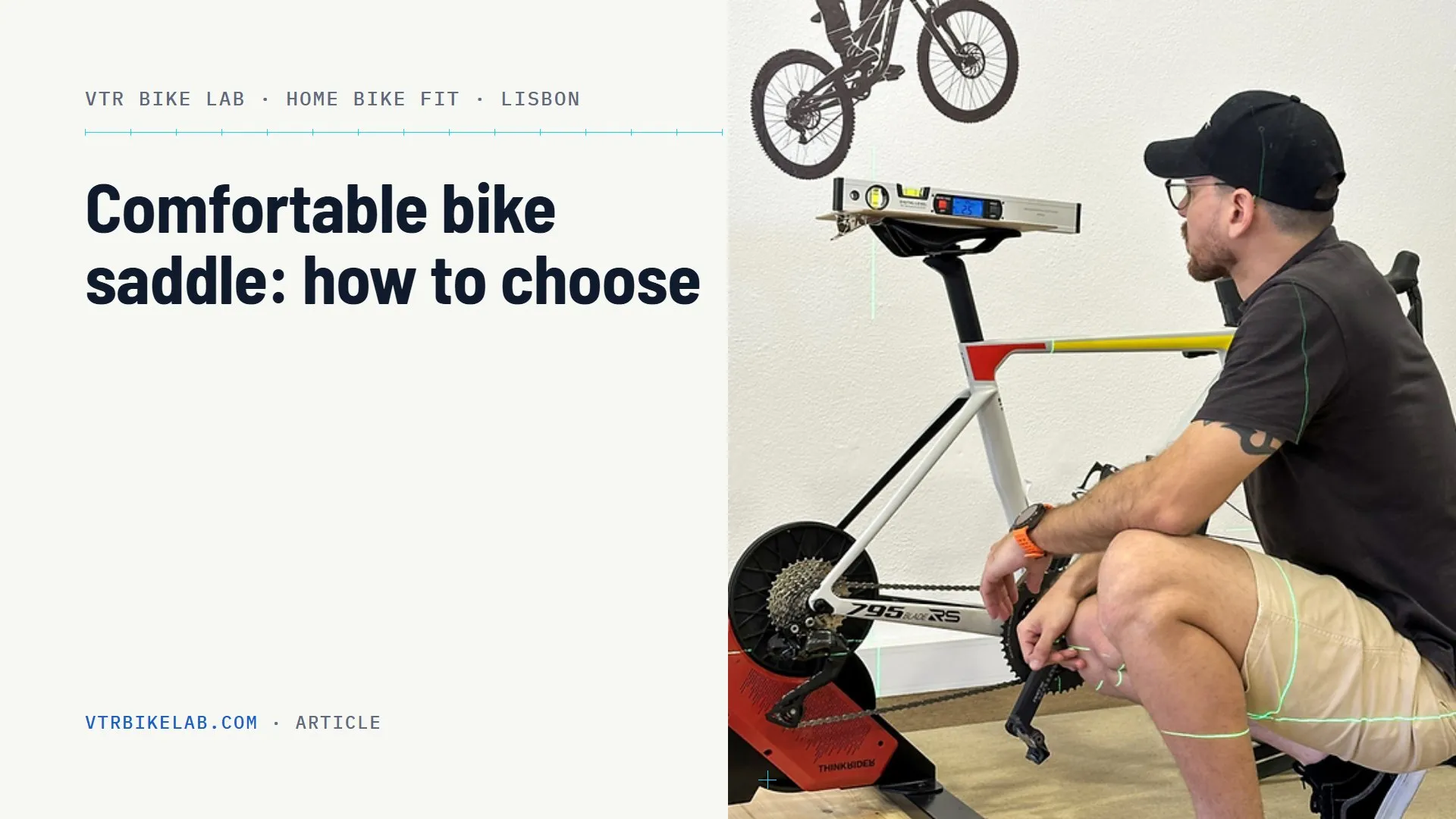
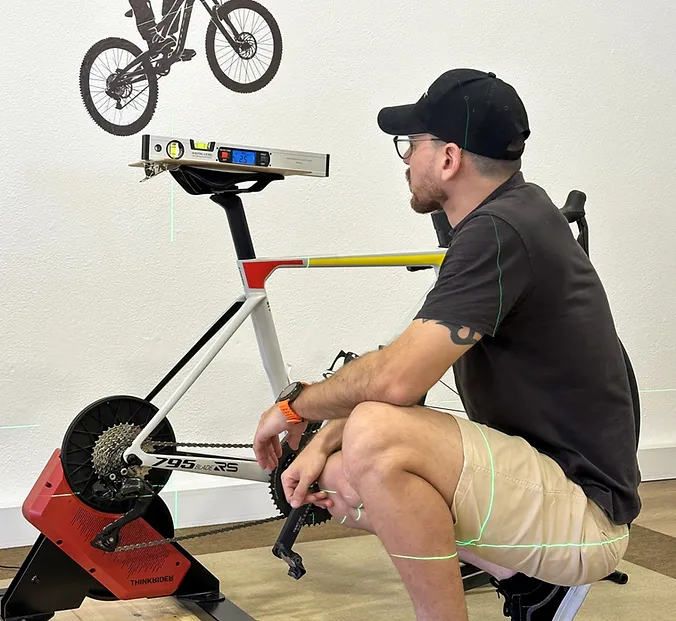
Think of a woman road cyclist who switched to a wide saddle with a cut-out, sold as a “women’s saddle”, and still has numbness after an hour and a half. Before she buys another one, I measure the sit bones and level the current saddle with the digital level.
Then I film the pelvis while pedalling. If it rotates forward, I first adjust the tilt, the height and the setback, and only then test another width or another design. If the numbness persists off the bike, see a doctor.
What to do today
- Measure the distance between your sit bones with corrugated cardboard.
- Get up off the saddle roughly every 10 minutes (Litwinowicz, 2021).
- Before buying another saddle, check the height and the tilt of the current one.
When this gets measured
Numbness and discomfort on the saddle depend on the tilt, the height and the setback as much as on the saddle itself. In the bike fit, at your home, I level the saddle, measure height and setback and see how the pelvis sits while you pedal on the turbo trainer.
If you want to try before you buy, there is the Saddle test + basic adjustment, for €127. You try several different saddle platforms, and the saddle height and fore/aft are adjusted with software and markers capturing the angles. The saddle you choose is paid for separately. With the Bike Fit Performance, the two together cost €189.
I do not diagnose or treat: with numbness that persists off the bike, burning when urinating or genital pain, see a doctor.
Frequently asked questions
What is the most comfortable bike saddle? The one that supports your sit bones and does not load the perineum, with the width of your measurement. There is no one model that is best for everyone: measure your sit bones, try saddles and set the height, setback and tilt before changing.
Women’s bike saddle: which one to choose? Choose by the width of your sit bones, not by the label. In competitive cyclists, wider saddles had less pressure (Guess, 2011); in club cyclists, they were associated with more burning when urinating (Hermans, 2016). Try before you decide.
Is a saddle with a central cut-out better? Not always. In 48 competitive cyclists, the saddle with a cut-out had more perineal pressure than the traditional one (Guess, 2011). Try both designs, with the saddle properly level and at the right height.
Sources
- Litwinowicz K, Choroszy M, Wróbel A. Strategies for Reducing the Impact of Cycling on the Perineum in Healthy Males: Systematic Review and Meta-analysis. Sports Med. 2021;51(2):275-287. DOI 10.1007/s40279-020-01363-z · PMID 33074460 — https://pubmed.ncbi.nlm.nih.gov/33074460/
- Guess MK et al. Women’s bike seats: a pressing matter for competitive female cyclists. J Sex Med. 2011;8(11):3144-53. DOI 10.1111/j.1743-6109.2011.02437.x · PMID 21834869 — https://pubmed.ncbi.nlm.nih.gov/21834869/
- Hermans TJ, Wijn RP, Winkels B, Van Kerrebroeck PE. Urogenital and Sexual Complaints in Female Club Cyclists—A Cross-Sectional Study. J Sex Med. 2016;13(1):40-5. DOI 10.1016/j.jsxm.2015.11.004 · PMID 26755085 — https://pubmed.ncbi.nlm.nih.gov/26755085/
- Sommer F et al. Erectile dysfunction in cyclists. Is there any difference in penile blood flow during cycling in an upright versus a reclining position? Eur Urol. 2001;39(6):720-3. DOI 10.1159/000052533 · PMID 11464064 — https://pubmed.ncbi.nlm.nih.gov/11464064/